AI Drafts and the Hidden Work of Sounding Like You
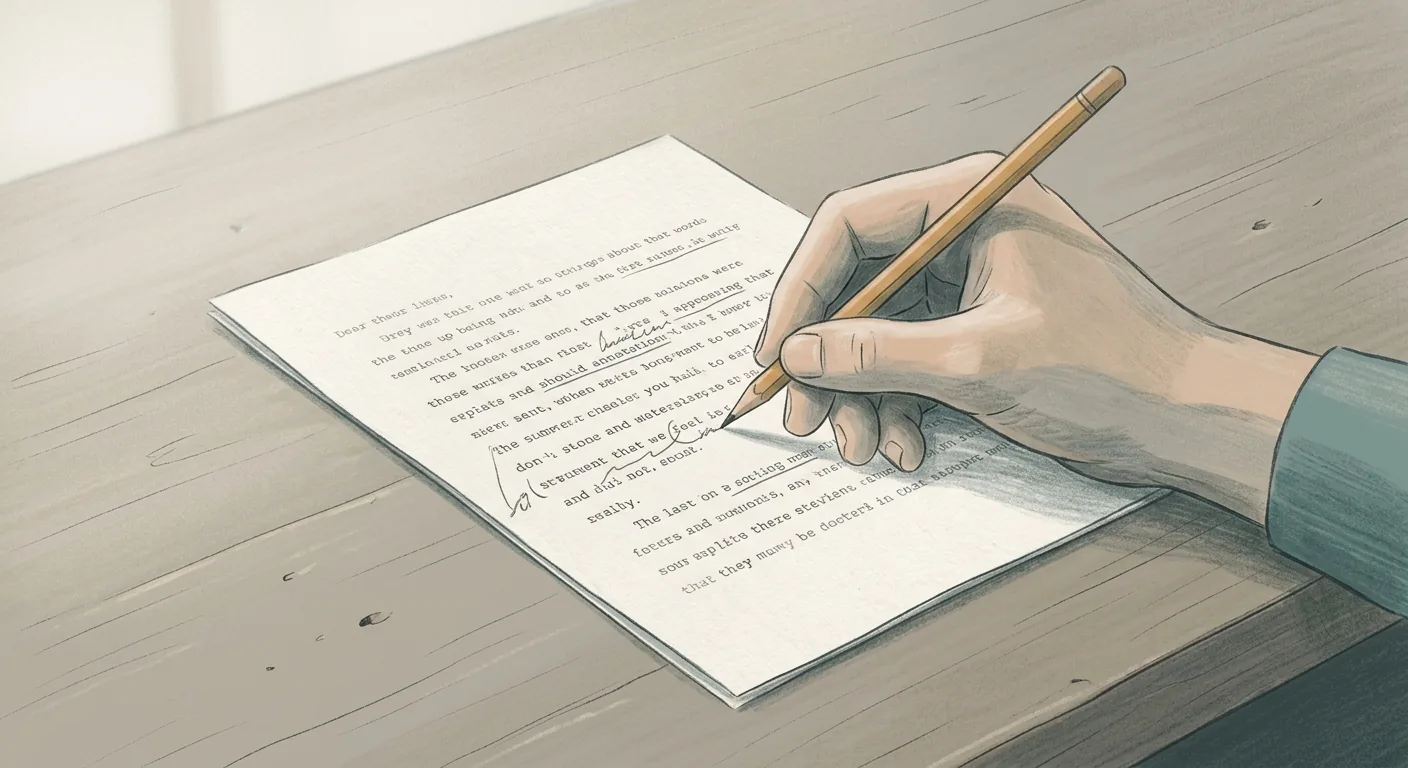
New research names a task that AI drafting quietly adds to a workday: the unpaid work of rewriting machine output until it reads as genuinely yours, plus the small decision about whether to say the AI helped.
New research names a task that AI drafting quietly adds to the workday: the unpaid work of rewriting machine output until it reads as genuinely the writer's own, plus the small decision about whether to mention the AI helped. The draft is fast. Sounding like a real person is the slow part, and it sits close to a sense of professional identity.
Last week I watched a colleague accept an AI draft of a project update, then spend the next twenty minutes quietly taking it apart. Not fixing errors. Changing “utilize” to “use.” Cutting a line that sounded too smooth. Adding the small aside she would actually say. The draft took a minute. Sounding like her took twenty. That second part has a name now.
What the research shows
The name comes from a study published in Frontiers in Psychology in April. Researchers at a communications university in Beijing ran sixteen long interviews with people who make short videos for a living, all of them using AI tools to draft scripts and captions. The researchers were after one question: when the AI does the first draft, what work is left?
Quite a lot, it turns out, and most of it is invisible. They named two things. The first they call “AI passing”: the effort to reshape an AI-assisted draft so it reads as fully human-written. The second is the labor that passing takes. It showed up in four forms. Checking whether the AI is actually right, because it is often confidently wrong, the same gap between an AI’s confidence and its accuracy that keeps surfacing in other research. Rewriting the machine’s voice into a recognizable human one. Rebuilding a generic structure into something with a point of view. And, for video, performing it so it lands like a person talking.
One creator the researchers interviewed put the arithmetic plainly:
"AI generates a draft in 10 minutes. I spend 90 minutes verifying facts."
The researchers borrowed the word “passing” from a sociologist who used it, decades ago, for the work of managing information about oneself that others might hold against you. Reading that, the shift is hard to miss. The fast part of the job got faster. The part that takes real time is everything after, and a lot of that time goes into a quiet question of whether the words carry a real sense of authorship or just a convincing imitation of one.
What it doesn’t tell us yet
This is one study, and a small, close-up one. Sixteen interviews, one country, one occupation. The people in it make short videos; they are not engineers or analysts or marketers, and the study does not measure how common any of this is. The researchers are careful on the next point: they argue the idea travels to other kinds of knowledge work, where AI is now common and where people are still expected to author what they produce. That is their reasoned argument, not something sixteen interviews proved. Treat it as a sharp name for something many of us have started doing, not as a settled measurement.
The draft is not the work anymore. The work is making it sound like a person, and deciding who gets to know how it was made.
One Thing to Notice This Week
Notice the rewrite pass. Not to stop it, and not to feel bad about it. Just to see it as work. When a draft comes back fast and the next stretch of time goes into changing the voice, trimming the too-smooth lines, and putting back the things a real person would say, that stretch is labor. It is the same pattern as the question of where coding-agent ROI shows up first: the effort did not disappear when the tool got fast, it moved somewhere quieter and lost its name.
And notice the smaller moment: the half-second where you decide whether to mention the AI helped. There is no right answer to hand over here. It is worth seeing that the decision is now part of the job, and that making it on autopilot is still making it. The new shape of the work gets figured out one ordinary draft at a time, and noticing it is the first calm step.
Sources
- AI passing and invisible authenticity labor: trust vulnerabilities and inequality in China's short-video creator economy - Frontiers in Psychology, 2026-04-28