Why AI quant funds posted 0.9% in April while discretionary funds ran 7%
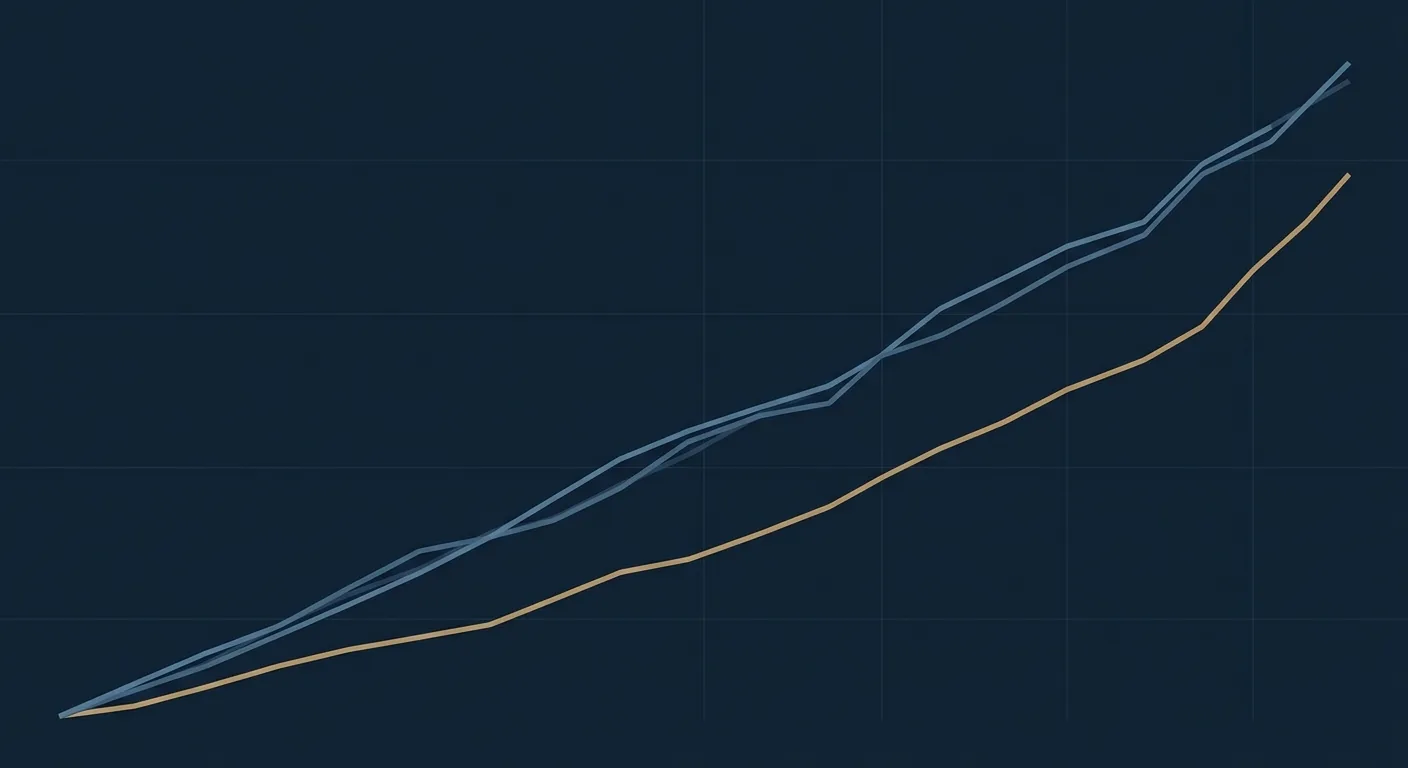
AI quant strategies returned a modest 0.9% in April 2026 while discretionary equity managers ran 7%. The mechanism behind the gap is structural model convergence, not classical signal decay, and it lives in the model layer rather than the position layer.
The first quarter tape was uncomfortable. Industry-wide hedge fund returns came in at minus 1.4 percent on a weighted basis, the first negative quarter since 2022 and the end of a thirteen-quarter winning streak. Then April happened. Hedgeweek’s recap on May 12 reported that PivotalPath’s Equity Quant Index returned 0.9 percent for the month. The Equity Diversified Index, dominated by discretionary stock-pickers, returned 7.0 percent in the same window. That gap is the story. We have spent two years reading that AI was about to eat asset management. The funds that lean hardest on machine-learning signals just spent a month losing to fundamental analysts running spreadsheets. The interesting question is not whether AI quant strategies are good. It is why so many of them crowded each other out at the exact moment the rest of the industry found its footing again.
AI quant strategies posted a modest 0.9 percent gain in April 2026 while discretionary equity managers ran 7 percent. The mechanism is not classical signal decay or capacity-driven slippage. It is structural model convergence: when many funds train similar models on overlapping public data, their signals arrive together, and the trade is crowded before any flow is even visible.
What the data shows
Here are the prints, in order. Hedge Fund Research’s Equity Market Neutral Index, which tracks the systematic strategies where machine-learning signals are most concentrated, fell 1.58 percent in March 2026, with losses tied to mean-reverting and factor-based positioning. April brought a recovery, but a modest one. The PivotalPath Equity Quant Index returned 0.9 percent for the month. Over the same window, the PivotalPath Equity Diversified Index, which captures discretionary equity managers, returned 7.0 percent. Sector-focused equity strategies returned 6.8 percent. Asia equity diversified long-short funds returned 9.0 percent. Equity market neutral returned 1.4 percent. The dispersion between systematic and discretionary equity in a single month came in above six percentage points.
Underneath the index numbers, the named-fund picture is messier than the headline. Bloomberg reported on April 6 that Two Sigma’s biggest hedge funds outperformed multistrategy peers through a chaotic March, even as the firm worked through internal executive disputes. Reuters figures cited in HedgeCo’s May 4 recap give Bridgewater’s Pure Alpha 34 percent, Balyasny 16.7 percent, and Point72 17.5 percent across the recent window. Hedge fund inflows hit roughly 45 billion dollars in the first quarter per Hedge Fund Research, and trailing two-quarter inflows are near 90 billion dollars, the strongest two-quarter haul since 2007. Capital is still arriving. It is arriving disproportionately at the strategies that are still finding edge.
| Strategy | April return |
|---|---|
| Asia equity diversified long-short | 9.0 |
| Equity diversified (discretionary) | 7.0 |
| Sector-focused equity | 6.8 |
| Multi-strategy | 1.6 |
| Equity market neutral | 1.4 |
| Credit | 1.3 |
| Global macro | 1.0 |
| Equity quant | 0.9 |
What is striking is the cluster. Systematic strategies sit around 1 percent. Discretionary equity sits around 7 percent. The dispersion is structural, not noise.
The mechanism behind the gap
Here is the mechanism most coverage misses. The standard frame for AI-quant underperformance is classical signal decay. A model finds an edge, the edge gets discovered, the trade gets crowded, the edge dies. That story has been told since the 1990s and it is still partly true. It is not, on its own, what is happening this spring.
In the older world, a single fund discovered a signal, traded it for some months, and then watched as imitators eroded it. Crowding was sequential. Funds arrived at the trade one after another.
In the AI-driven version, the funds do not arrive sequentially. They arrive together. When many quant managers train similar transformer architectures on overlapping public data, ingest the same Bloomberg and Reuters feeds, and retrain on near-identical cycles, their models are not independent. They are correlated by construction. The signal is not discovered late by imitators. It is generated simultaneously, by many funds at once, for the same names, on the same day.
The Bank of England has started naming this carefully. Its April 2026 Financial Policy Committee record says firms have yet to deploy advanced and agentic AI in ways that pose systemic risk today, but adds that risks could rise rapidly. Sarah Breeden, the Bank’s Deputy Governor for Financial Stability, has flagged herding behavior among AI agents as a focus of new market simulations the Bank is running with international counterparts. A formal model published on arxiv in April (paper 2604.03272) gives the cleanest framing I have seen: in AI-driven markets, correlation arises from shared information production technology rather than from copied positions. The crowding has migrated from the position layer to the model layer.
The decay does not happen because the trade gets stale. It happens because the trade arrives crowded.
Classical signal decay is sequential: a fund discovers an edge, others copy it, the edge dies. Model-layer crowding is simultaneous: funds with similar models on similar data generate the same signal on the same day, and the trade is crowded the moment it appears. The fix for the old problem (faster execution, better entry) does not work on the new one.
The honest version
A fair statement of what is happening: machine-learning signals are still real. They are still generating positive returns in many windows. They just no longer have a private window before the rest of the systematic ecosystem arrives at the same trade. That is why an April that should have looked like a quant comeback printed at 0.9 percent instead of 5 or 6.
The PivotalPath line is worth reading in its calm institutional register:
"The PivotalPath Equity Quant Index showed that quant strategies delivered a modest gain of 0.9% for the month."
The word that matters there is modest. Not strong. Not rebound. Modest, in a month when the discretionary universe ran 7 percent. The first quarter numbers had already told us something. April told us it was structural rather than a one-month event. The funds that crushed it through this period were the ones whose edge was not delivered through a generic foundation model. Citadel’s chief technology officer, Umesh Subramanian, said it about as cleanly as anyone has this month. Simply using AI, in his framing, will not automatically make someone a much better investor. The final judgment, he added, still sits with humans.
The crowding has migrated from the position layer to the model layer. The fix for the old problem does not work on the new one.
What we do with this
Three things follow for us as people running real money.
First, when an AI-themed fund or exchange-traded fund describes its model, the honest question is not what data it uses. It is how unusual the data and the model architecture actually are. A public-data foundation model on a standard transformer architecture sits in the crowded layer by construction, no matter how much marketing the manager wraps around it.
Second, watch the monthly spread between equity diversified and equity quant indices. When the gap widens past three or four percentage points, the model-layer crowding mechanism is active. When it narrows, idiosyncratic edge is being found again. The spread is the cheapest tell on whether systematic land has its footing back.
Third, the systematic survivors of this decade will be funds with proprietary data, idiosyncratic architectures, or a meaningful human overlay. The rest are increasingly running each other’s positions.
Closing observation
The interesting question for the next two quarters is not whether AI quant funds find their footing again. It is whether the six-point spread between systematic and discretionary equity is the new normal or a temporary regime. If the gap holds through summer, model-layer crowding is no longer a curiosity. It is a structural feature of how the systematic universe trades, and it changes what we should expect from any product that bills itself as AI-driven.
This is editorial analysis, not investment advice. Cerevisor does not hold or recommend the named positions, and information here can become stale within hours of publication.
Sources
- April market rebound tests quant strategies as hedge funds regain momentum - Hedgeweek, 2026-05-12
- Citadel's Quant Chief: AI's New Market Paradox Faster Information, More Crowded Trades - HedgeCo Insights, 2026-05-13
- BlackRock Issues Crowding Warning for Hedge Funds - HedgeCo Insights, 2026-04-16
- Two Sigma Profits From Chaotic March, Beating Multistrat Peers - Bloomberg, 2026-04-06
- Bank of England Says it Is Testing AI Risks to Financial System - Insurance Journal (Bloomberg wire), 2026-04-17
- Quant Equity's Alpha Surge: Why Systematic Stock-Picking Is Back at the Center of the Hedge Fund Trade - HedgeCo Insights, 2026-05-04
- Artificial Intelligence and Systemic Risk: A Unified Model of Performative Prediction, Algorithmic Herding, and Cognitive Dependency in Financial Markets - arXiv q-fin, 2026-04-04
Written by Kinan Hamwi, Founder of Cerevisor.