Is your AI rollout changing how work gets done, or just adding tools on top?
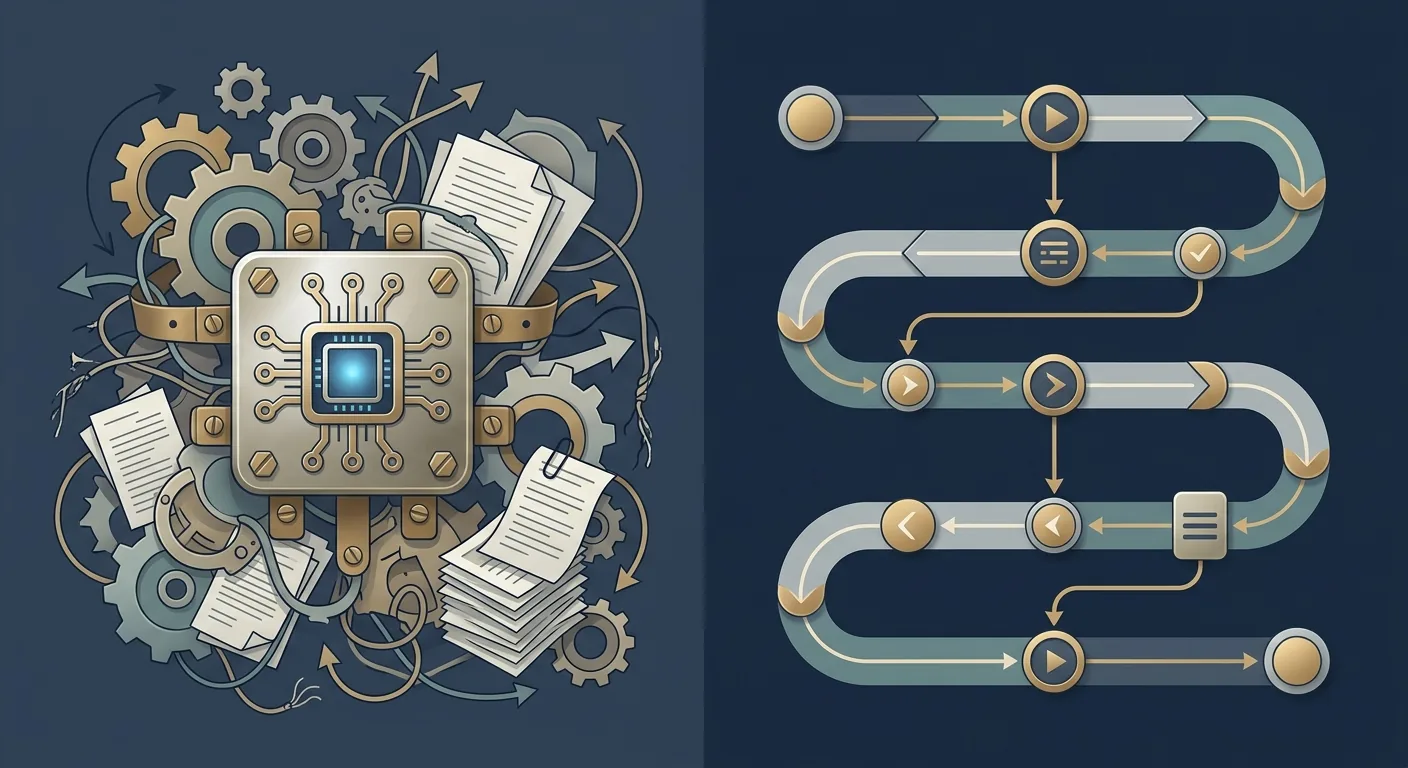
The people using AI most are the ones who feel less productive. New workforce data from 39,000 workers explains why, and why the fix is redesigning the work, not mandating more tool use.
New workforce data shows the people using AI the most are the ones who feel less productive, four times more likely than non-users to say so. That is not a failure of the tool or the team. It is the sign that the work around the tool was never redesigned. The fix is to find which tasks slowed down, rebuild that workflow, and direct the time AI frees up, not to mandate more usage.
I read a workforce digest this past Friday that named something I have been watching go unnamed for a year. A new round of survey data, covering 39,000 workers across 36 markets, found that the people using AI every single day were the most engaged and the least stressed in the building. They also reported feeling less productive than the people barely touching the stuff. Not a little less. They were four times more likely than non-users to say they were not as productive as they could be.
Read that twice, because it breaks the story most leadership decks are telling. The heaviest users, the ones a leader would call champions, are the ones quietly raising their hand to say something is off.
Any executive who has rolled out AI across a team and felt a strange gap between the energy in the room and the numbers on the board is looking at the explanation. And the conclusion is more hopeful than it sounds.
Why “more adoption equals more value” feels obviously true
The belief running underneath almost every AI plan I see is simple: if we get more people using AI more often, the productivity will follow. Usage goes up, output goes up, the line bends. It is the cleanest possible theory of change, which is exactly why boards love it and why so many companies now track AI seat activation like it is revenue.
And it sounds right because the individual experience is real. People genuinely save time. They draft faster, summarize faster, get unstuck faster. When someone says AI gave them back two hours on a Tuesday, they are not lying. The time savings at the task level are some of the most consistently measured numbers in this whole field.
So the logic seems airtight. People save time, people feel it, scale the saving across the org, and the P&L moves. The problem is that the last step has quietly refused to happen for most companies. The individual gains are real and they are not adding up.
What 39,000 workers reveal about the adoption-vs-impact gap
Here is the part that the digest, published June 26 by Asanify drawing on ADP Research’s People at Work 2026, laid out plainly. The daily AI users were 30 percent fully engaged versus 14 percent for non-users. They reported negative stress at 11 percent versus 23 percent. By every wellbeing measure, the heavy users are having a better time at work. And the same group is the most likely to feel they are underperforming.
The honest read is not that AI makes people worse. It is that we dropped powerful tools into workflows that were built for a pre-AI world, and then asked people to feel faster inside a process that was never reshaped to let them be.
The pattern shows up everywhere once it is named. Boston Consulting Group reported in early June that 42 percent of frontline AI users now save a full workday or more each week, but 66 percent get limited or no guidance on what to do with that freed-up time, and more than half never redirect it into anything strategic. So the time appears, and then it evaporates into the same inbox it always did. Back in April, Fortune covered an NBER survey of 6,000 executives in which nearly 90 percent said AI had no impact on employment or productivity over three years. Average usage in that group was 1.5 hours a week. The champions are flooring it and the org is idling, in the same building.
"Clear strategy lifts measurable business impact by 25 percentage points. In contrast, better tools, without that strategy and redesign, move it only by approximately 5 points."
That five-versus-twenty-five split is the whole argument in two numbers. Tools alone move the needle a little. Strategy and redesign move it five times more. The gap between heavy users feeling unproductive and the org seeing no impact is not a usage gap. It is a redesign gap.
The redesign gap, not the job-loss panic
Notice what this reframe quietly does to the scarier narrative. The story dominating headlines is that AI is coming for the jobs. The data sitting underneath this same digest says otherwise. SHRM economist Justin Ladner estimated that only about 6 percent of US jobs, roughly 9.2 million, face high near-term displacement risk, and his framing was that AI is transforming work rather than replacing roles outright.
So the real executive problem is not “how many people do I cut.” It is “how much value am I leaving on the floor because I bought tools and skipped the rebuild.” Those are very different problems, and the second one is the one a leadership team can actually do something about this quarter.
The mental model to hold is this. AI does not deliver value when it is adopted. It delivers value when the work is redesigned around what it now does well. Adoption is the cost. Redesign is where the return lives. Every champion feeling unproductive is a signal flare pointing at a workflow that still assumes they are doing the part the AI just took over.
When the best AI users feel slower, the workflow is the bug, not the person. They are doing the new fast part and the old slow part at the same time, and the old part is winning.
What changes when this becomes a workflow problem
The most useful line in that June 26 digest was its quietest. As Asanify framed the takeaway: “the engagement productivity gap closes through better process design, not louder adoption mandates.” I would put that on a wall.
Here is what it means for Monday. Stop measuring whether people are using AI and start asking which specific tasks got slower after the tools arrived. The champions already know. Ask the person who lives in the tool eight hours a day where the friction moved. It almost always moved somewhere, because the AI sped up one step and left the three steps around it untouched, so now there is a fast middle bolted between two slow ends and the handoffs got weirder.
Then redesign that one workflow. Not the whole company. One process, end to end, rebuilt around what the AI now handles, with the human steps placed where judgment actually matters. Then decide, out loud, what the freed-up time is for, because the BCG number says it will leak away if nobody names it. Saved time is not a result. Redirected time is.
And resist the mandate reflex. When usage looks low, the instinct is to push harder on adoption. The data says that is the move that does not work. The companies pulling ahead are not the ones with the loudest AI mandates. They are the ones who picked a workflow, rebuilt it, and let the tool do the part it is good at inside a process that finally fits it.
That is the calmer version of this whole story. The AI rollout is probably not failing. It is half-finished. The engine is bought and the car has not yet been rebuilt around it. The good news is that the second half is management, not magic, and it is the part you already know how to do.
Sources
- AI News Digest, June 26: The Workforce Data Cutting Against the AI Job Panic - Asanify, 2026-06-26
- Half of Global Workforce Using AI Weekly, Yet Frequent Users Question Their Productivity - ADP Research, 2026-05-14
- AI Is Reshaping Jobs Faster Than Companies Are Reshaping Work - Boston Consulting Group, 2026-06-03
- Why thousands of executives believe AI is not having an impact on productivity - Fortune, 2026-04-19
Written by Kinan Hamwi, Founder of Cerevisor.