Why more AI training won't fix your adoption problem
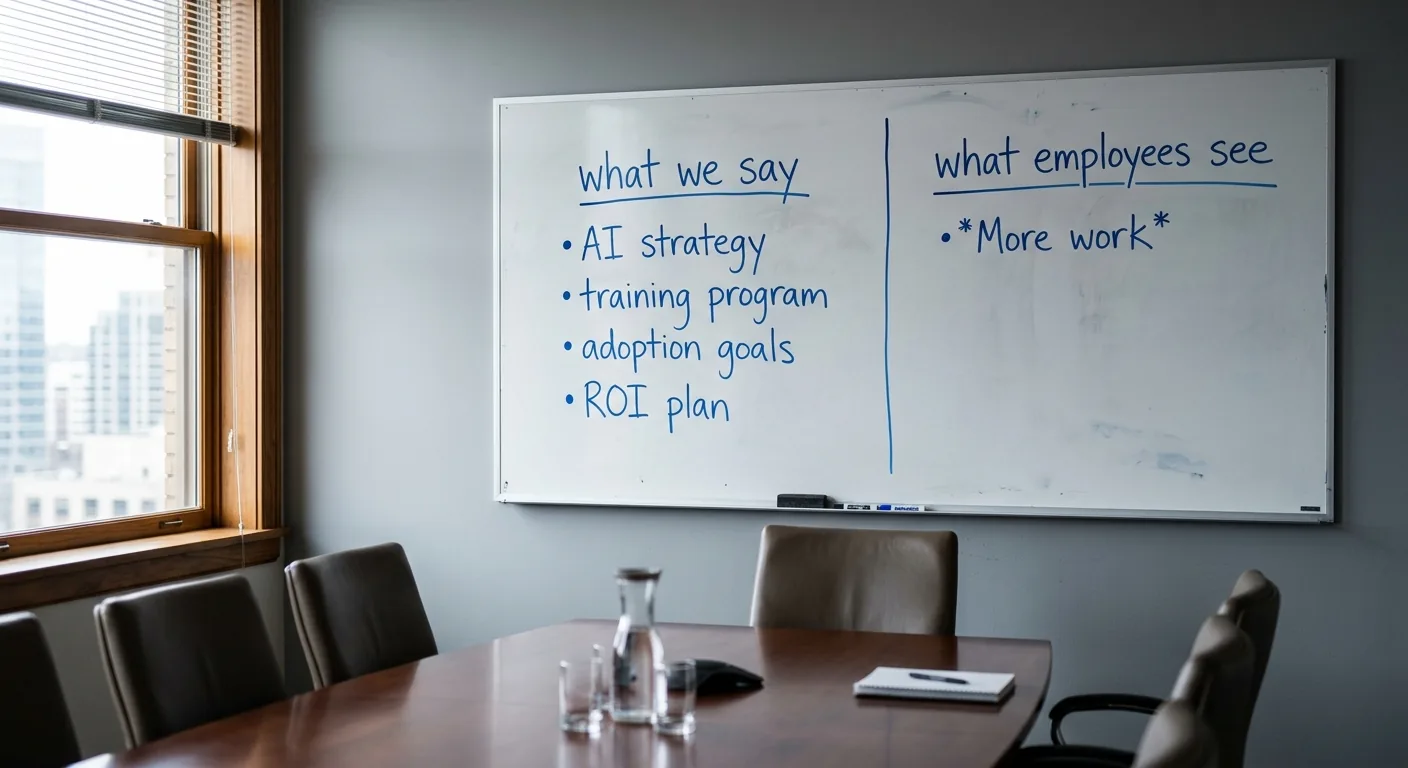
Two surveys released the same day reveal a say-do gap on AI workforce readiness. The fix is not more training. It is owning the gap, the manager layer, and the work design underneath both.
Two large surveys released May 4 land on the same finding from opposite ends of the building. 83% of CEOs say AI success depends on people's adoption, and 85% of business leaders quietly admit they feel pressure to look further along than they really are. The fix is not another training budget line. It is closing the say-do gap, making the manager layer the unit of accountability, and redesigning the work itself.
The myth
Adoption is low, the skills gap is real, so the answer is more AI training. Bigger budget, broader curriculum, mandatory hours per employee. Run the numbers up. Watch adoption follow.
I keep hearing this in CEO 1:1s. It is the cleanest, most fundable story on the table. It also happens to be the wrong one.
Why it sounds right
The story sounds right because the surface data is real. Employees do say they want training. Companies that offer training see higher self-reported adoption. The “train people” framing also has the bonus of being a problem the L&D team can run with on Monday, which makes it easy to approve.
Most companies of any scale have already done something like this. That is not the failure. The failure is what happens after.
What the evidence says
Two big surveys landed on May 4 and they tell the same story from opposite ends of the building.
The IBM Institute for Business Value released its 2026 CEO study, 2,000 CEOs across 33 countries with Oxford Economics. The headline is uncomfortable. Only 25% of the workforce uses AI regularly, even though 86% of CEOs say their employees already have the skills. Same survey: 83% of CEOs say AI success depends more on people’s adoption than technology.
Read those three numbers together. Adoption matters most. We believe our people are ready. They are not actually using it. That is not a training gap. That is a leadership gap dressed up as a training gap.
The Milken Institute-Harris Poll Listening Project, released the same day at the Milken Global Conference, surveyed 2,001 Americans, including 502 business leaders at the VP level and above from companies with $2 billion or more in revenue. It is the worker-side mirror.
"85 percent of business leaders admit feeling pressure to appear further along than they actually are."
The same release notes that 41 percent of workers received zero employer AI support in the past year. So when the boardroom says we are investing, training, equipping, the worker-side data says nothing arrived.
Now the operational data. Gallup’s April analysis of 23,717 U.S. employees found that workers with strong manager support are 9.3 times more likely to say AI has transformed how work gets done. Strong manager support also lifts frequent AI use from 44% to 78%. But only 52% of managers themselves use AI frequently. The bottleneck is not employees. It is the layer between the strategy deck and the desk.
And the structural piece. Jeff Carson at CIO.com noted on April 30 that executives see AI super-users as five times more productive than peers, yet only 29% of organizations report significant ROI from generative AI. Productivity is real in pockets. It is not surviving scale-out because the work around it has not changed.
The adoption gap is not a knowledge problem. It is a credibility problem at the top, a fluency problem in the middle, and a work-design problem at the bottom. Training spend touches none of those three.
The reframe
The better mental model is this. AI adoption is a three-layer system, and training is the smallest lever in it.
Layer one is honesty at the top. The 85% pressure stat is not a moral failing. It is structural. Boards ask for AI numbers, peers post AI numbers on LinkedIn, leaders produce AI numbers. The cost is that the workforce hears a story they cannot match to their own experience, and trust degrades. The CEOs I know who actually move adoption have one habit in common. They publicly say the unflattering version first. “Here is where we are. Here is where we are not. Here is what changes by next quarter.” That act of calibration buys more adoption than a quarter of training.
Layer two is the manager. Gallup’s 9.3x multiplier is the most actionable stat in the data set. Treat managers as a training audience and the rollout stalls. Treat them as the unit of AI accountability, where each manager owns their team’s adoption, fluency, and live use cases, and it moves. That changes who sits in the AI steering committee, what gets tracked in the manager scorecard, and how promotion works at the director level.
The bottleneck is not employees. It is the layer between the strategy deck and the desk.
Layer three is work design. This is the Carson point and the hardest to fund because it has no obvious owner. Teach a sales rep prompt engineering and then send them back into the same eight-step approval workflow and the same compensation plan that rewards activity over outcomes, and nothing changes. The 5x super-user productivity happens because those people redesigned the workflow around themselves. Most have not. So productivity stays in pockets and ROI stays at 29%.
Training is the easy budget line. Honesty, manager fluency, and work redesign are the hard ones. They are also the only three that move the number.
So what
Three things change this quarter.
First, run the say-do gap audit. Pull AI claims from the last earnings call, all-hands, and board deck, and put them next to what workers would say if surveyed today. Acknowledge the delta publicly before someone else does it first. The 85% pressure stat is permission. If most leaders feel it, naming it is leadership, not weakness.
Second, move AI accountability to the manager layer. Not a horizontal center of excellence, not a quarterly literacy course, but a line in the manager scorecard. Each director owns their team’s adoption rate, three live use cases, and their own usage frequency. IBM found 59% of CEOs expect CHRO influence to grow. This is what that means operationally.
Third, redesign one workflow per function before authorizing the next training cohort. Pick the highest-friction, highest-volume workflow. Map it as it runs today. Identify where AI changes the shape of the work, not just the speed of a step. Rebuild it. Then teach to that.
The funny part is that the answer was sitting in the data the whole time. CEOs already say people adoption is the bigger lever. Workers are already telling pollsters they got nothing. Managers are already the strongest predictor of whether anything sticks. The disconnect is not absence of evidence. The easy budget line gets approved. The harder three do not.
If a rollout is stalling and the next instinct is another round of training, take a breath. The companies pulling ahead this year stopped buying that answer. Start with the gap already in plain sight.
Sources
- IBM Study: CEOs are Reshaping C-suite Roles for the AI Era - IBM Newsroom, 2026-05-04
- New Milken Institute-Harris Poll Finds Historic Consensus on AI Workforce Policy, but a Critical Gap Remains Between Employer Intent and Action - Milken Institute-Harris Poll Listening Project (via Newswire), 2026-05-04
- AI in the Workplace: What Separates Adopters and Holdouts - Gallup, 2026-04-13
- You can't train your way out of the AI skills gap - CIO.com, 2026-04-30