Is the 4pm closing auction still the fairest price of the day?
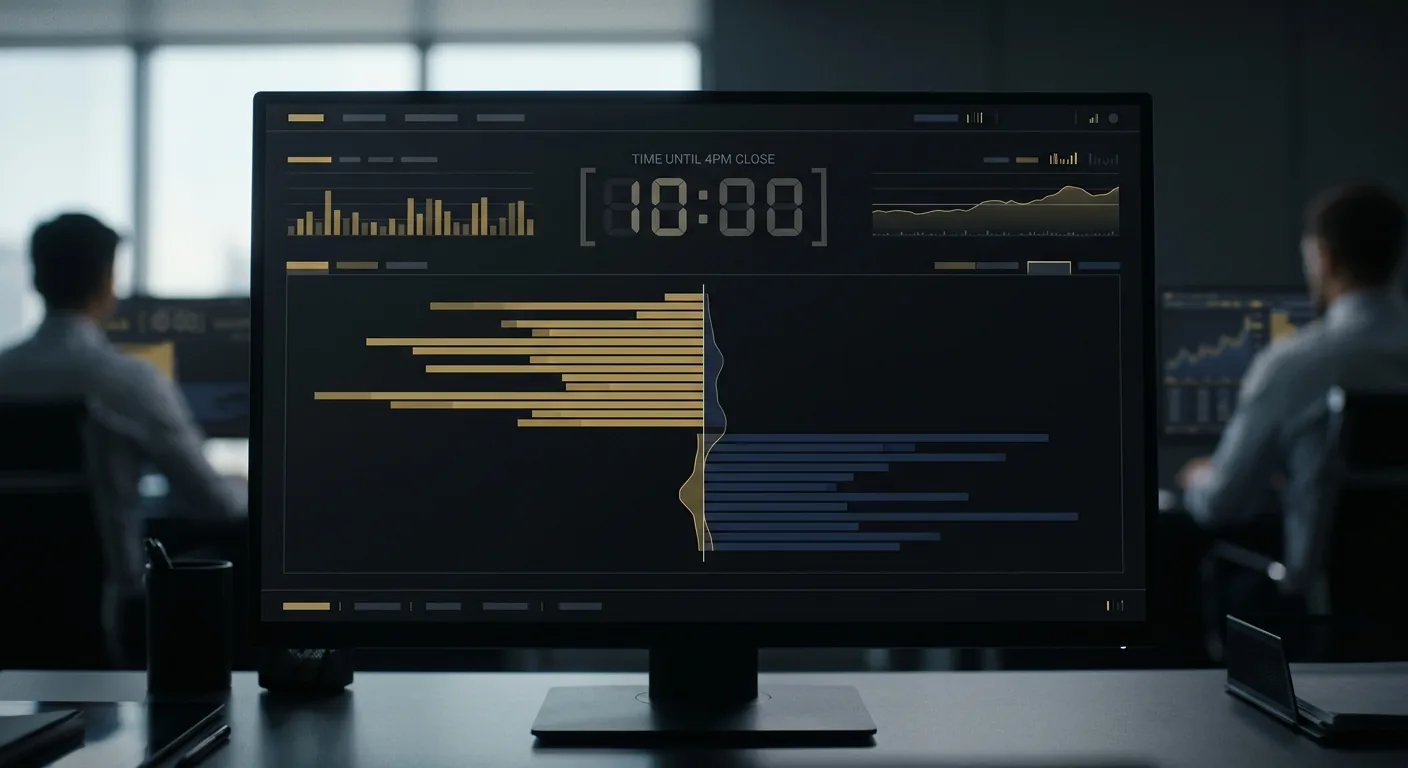
The 4pm closing auction is widely treated as the day's fairest price, but exchanges broadcast a live order-imbalance feed for the final ten minutes before the cross prints. That makes the official close a public deadline shaped by whoever reads the feed fastest, which changes how we should trade into it.
The 4pm closing auction now prints 15.39% of US daily equity volume, up from 8.40% in 2018, and for its final ten minutes the exchanges broadcast a live order-imbalance feed that shows which way the close leans. That makes the official close less a neutral price than a public deadline, which changes how we should trade into it, especially in smaller names.
The close is supposed to be the honest price
This Wednesday, May 20, the Federal Reserve’s April meeting minutes land in the afternoon and Nvidia reports after the bell, with options pricing a move of roughly 6% on the stock and 2.6% on the Nasdaq-100 over the week. On days this loud, a belief many of us carry quietly resurfaces: the 4pm closing price is the honest one. The intraday tape is noisy, full of flickering quotes and headline whiplash, but the official close is a single clearing price where everyone meets at once. So if we want a fair fill, we wait for the auction. Brokers reinforce it, offering a market-on-close order, an instruction to trade at whatever single price the 4pm auction settles on, as the calm, grown-up option. The close is the number that goes into the index, the fund statement, and quietly into our own mental accounting. Surely that makes it the fairest price of the day.
The myth used to be true
Like most durable beliefs, this one started as fact. For decades the close genuinely was the cleanest moment in the session. A single batch auction collects every buy and sell order willing to transact at one price, matches them, and prints. No spread to cross, no working an order across a dozen venues, no information leaking out one slice at a time. For an index fund it was a gift. Its net asset value, the official per-share value the fund is measured against, is struck off closing prices, so transacting in the auction means matching the benchmark and keeping tracking error near zero.
That logic was sound when the close was a sideshow. It is no longer a sideshow. State Street Global Advisors measured how far the ground has shifted: in January 2018, closing auctions handled 8.40% of US daily equity volume; by December 2025 that share was 15.39%, and the line only points up.
What the data says about the close now
| Market | Jan 2018 | Dec 2025 |
|---|---|---|
| United States | 8.40% | 15.39% |
| Developed Europe | 19.59% | 34.82% |
A main event behaves differently from a sideshow. The NYSE closing auction matched an average of 605.5 million shares, about $43 billion, every day in the first quarter of 2026, and on March 20 it set a single-day record of 3.57 billion shares worth $230.5 billion. Concentration at that scale carries a cost the headline volume hides: not every order that wants the closing price can get it.
"a total of 18mn shares remained unfilled on a daily basis due to a lack of contra-side liquidity"
That is roughly $530 million of intended trades that did not happen each day, rising toward $1 billion on big index rebalance dates. The shortfall is not evenly spread. Unfilled interest ran at 3.3% of executed auction volume overall, but 6.3% for stocks outside the Russell 1000, the small and mid-cap end. More than a quarter of all closing auctions had at least 2% of their volume cancelled back for want of a counterparty, and for smaller names it was closer to one in three. The close is a clean single price only when there is enough on the other side. In thinner names, often there is not.
The ten minutes with the cards face up
Here is the part the myth never updated for. The auction is not sealed. From 3:50pm, NYSE and Nasdaq each broadcast an order-imbalance feed, the running tally of how many more shares want to buy than sell at the close, with direction and size, updated continuously through the final ten minutes.
Anyone watching that feed sees which way the close leans before it prints. Market-on-close orders sit there visible in aggregate, and faster participants, for years algorithms and now increasingly autonomous agents, can lean against them, supplying or pulling liquidity to nudge where the cross settles. The feed exists for a good reason, to draw counterparties toward exactly those 18 million unfilled shares. The side effect is structural: when auction volume is heavy, State Street’s researchers note, the close shifts from price-revealing to price-forming, it stops discovering the day’s equilibrium price and starts setting one that can drift from it. A market-on-close order is a commitment to trade before knowing the price, made while the rest of the room can see the shape of our hand.
The official close is not a sealed auction. For its final ten minutes it runs with a public scoreboard, so the "fairest price of the day" is really the price set by whoever reads the imbalance feed fastest.
So how should we trade into the close
This is not a case for avoiding the close. For a large position in a deep S&P 500 name, the auction is still excellent: an order is a raindrop in that $43 billion ocean, and the imbalance feed barely registers it. The reveal is that “fair” depends on the name. In a thin small or mid-cap stock, where one in three auctions already struggles for a counterparty, the same ten-minute feed turns a modest order into a visible target. There, a limit-on-close order, which sets a worst acceptable price rather than accepting whatever prints, caps the damage. And on a pre-positioned day like May 20, the close is the most-watched ten minutes of the session, not the calmest.
The closing price will still be the number in tomorrow’s paper, and for most of what we hold it is a perfectly good number. What is worth sitting with is smaller and stranger: the one moment we trust most for being neutral is also the one moment the whole market is told, in advance, which way we are leaning.
This is editorial analysis, not investment advice. Cerevisor does not hold or recommend the named positions, and information here can become stale within hours of publication.
Sources
- Behind the Record Volumes: A Hidden Opportunity - NYSE, 2026-04-08
- Closing time: How passive investing is reshaping equity market microstructure - State Street Global Advisors, 2026-01-23
- The NASDAQ Opening and Closing Crosses - Nasdaq
- The Week Ahead: NVDA, Big Box Stores, and FOMC Minutes after Inflation and Yields Spike - RiskReversal, 2026-05-17
- Week Ahead: Nvidia, Retailers, and Fed Minutes Take Center Stage - Schwab Network, 2026-05-17
Written by Kinan Hamwi, Founder of Cerevisor.