The second pilot wall, and what Anthropic and OpenAI both quietly admitted on Monday
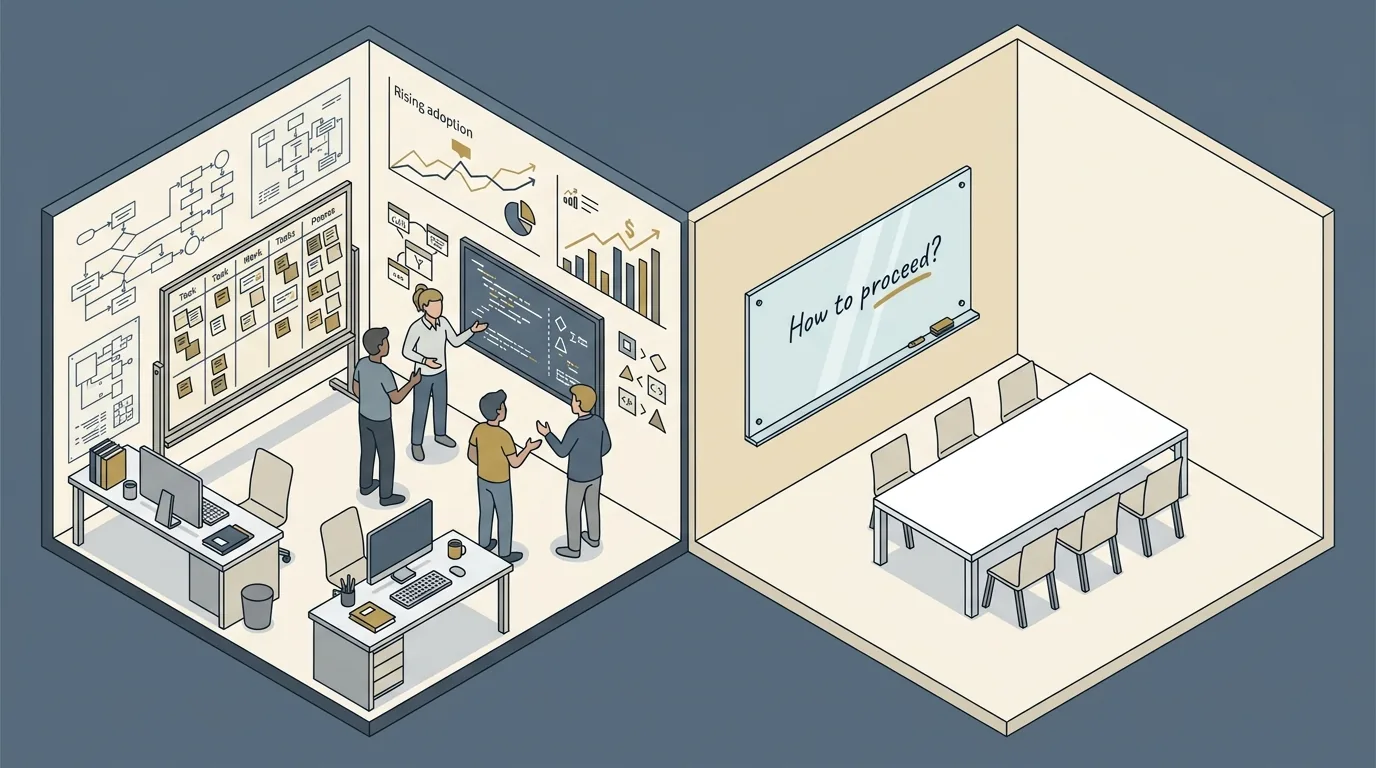
On May 4, Anthropic and OpenAI both announced billion-dollar enterprise services ventures. Both bet on the same admission: enterprises buy the model and then stall on deployment. For executives whose first coding-agent pilot worked and whose second one keeps slipping.
On May 4, Anthropic and OpenAI both announced billion-dollar enterprise services joint ventures with private-equity capital. Both ventures import Palantir's forward-deployed-engineer model. Both quietly admit the same thing every executive sees in their second coding-agent pilot: the model alone does not deploy itself, and the deployment cost is a 5x to 10x multiplier on the procurement line.
I had three calls in the past two weeks with executives whose first coding-agent pilot quietly succeeded and whose second pilot is somehow not happening. Same harness. Same procurement path. Same “we already did this” expectation. The seats were approved. The kickoff was scheduled. And then, nothing moves.
If that sounds familiar, it should. On Monday, Anthropic and OpenAI both publicly admitted why.
The myth
The myth goes like this. If we picked the right harness, the rollout scales itself. Claude Code or Cursor or Codex worked for the first team. So the second team is mostly a procurement question. Add seats, send the welcome email, watch productivity climb. The harness is the substrate. Everything else is admin.
This is the most expensive false belief in 2026 enterprise AI. It is also the one nobody wants to say out loud, because saying it sounds like criticizing the harness, which sounds like criticizing the champion who picked it, which sounds like a reorganization waiting to happen.
Why it sounds right
The first pilot, the one your champion ran, looked like clean math. Adoption was strong. The developer survey came back happy. The productivity story landed at the next leadership offsite.
The market data backs up the gut feeling. Anthropic’s annual revenue run rate is past $30 billion as of March, per SiliconANGLE’s Monday coverage. Cursor sits inside roughly two-thirds of the Fortune 500. Microsoft’s Copilot CLI is doubling month-on-month. The whole market reads as if the vendors solved the hard problem and the rest is invoicing.
If the harness was the bottleneck, the second team would be the easiest deployment any platform org ever did. It is not. That gap between expectation and reality is the data point your gut is registering, even when nobody on the call has a name for it yet.
What the evidence actually says
What the evidence actually says: on May 4, Anthropic announced a $1.5 billion enterprise AI services firm with Blackstone, Hellman & Friedman, and Goldman Sachs. The same morning, OpenAI closed a $10 billion vehicle called The Deployment Company, backed by 19 investors led by TPG, Brookfield, Advent, and Bain. Both ventures explicitly import Palantir’s forward-deployed-engineer model. Both target mid-sized companies. Both will embed engineers inside customer organizations to actually integrate the model into the workflows people already use.
This is not the move you make when the harness alone is doing the work.
Anthropic CFO Krishna Rao framed it with surprising clarity in the company's Monday announcement: "Enterprise demand for Claude is significantly outpacing any single delivery model." Goldman Sachs's Marc Nachmann was blunter on SiliconANGLE: there is a "big shortage" of people who know how to integrate AI with existing business processes, and "having the model alone doesn't change your workflows or how you operate."
The unit economics tell the same story. Blackstone president Jon Gray put a number on it on Fortune the same day.
"For every dollar companies spend on software, they spend six on services."
PYMNTS, reporting on the same announcement, put the AI-specific multiplier at “$5 to $10 on integration, compliance and monitoring” per dollar of model spend. Whether the right number is six or eight or ten, the shape is the same. Software-tier procurement is a fraction of what it costs to actually deploy.
That is what the dual joint-venture announcement is pricing. The PE consortium is not betting on the model. The model is mostly settled. They are betting on the services layer that turns a working pilot into a running second pilot, and a third, and a fourth.
The reframe
So here is the reframe. The first pilot did not succeed because the harness was the substrate. It succeeded because somebody, usually a platform engineer or staff-level contributor with seven dashboards open at once, absorbed the integration cost on personal time. They wrote the prompt patterns. They tuned the merge gates. They babysat the cost dashboard. Their work was invisible, which is exactly why it did not get budgeted.
The second team has no champion. There is nothing for the integration cost to hide behind. So the cost shows up on the procurement sheet for the first time, and procurement reads it as a contract problem rather than a deployment problem.
The pilot stalls at the meeting where someone says "wait, why is this getting more expensive than the per-seat number we approved." That is the wall.
This is also the moment most exec teams quietly conclude the harness was oversold. It was not oversold. The harness is doing what it said on the box. What was missing was the line item below the harness.
So what
Three things I would actually do before approving the second pilot.
First, name the human deployer. Forward-deployed engineer is the model both labs are buying for roughly $11.5 billion combined. Pick yours, internally or externally, before the seat license, not after. Internal is fine. External is fine. No name attached is the only wrong answer.
Second, budget the multiplier explicitly. Whether you trust Gray’s six-to-one or the wider five-to-ten range that PYMNTS reported, attach a deployment line to the procurement line. The number will not embarrass anyone. The number not being there will, three months in, in front of the CFO.
Third, make the first-pilot champion visible. Find the staff-level person who absorbed the integration cost the first time. Either name them as the deployer of the second pilot, or hire the second deployer next to them. Do not assume the work travels by itself. It does not. That is the whole story.
The harness was always the easy part. The hard part, the part Anthropic and OpenAI just put $11.5 billion behind on a Monday morning, is the part you can plan for now, before the second pilot becomes a budget conversation in a room nobody enjoys being in.
Sources
- Building a new enterprise AI services company with Blackstone, Hellman & Friedman, and Goldman Sachs - Anthropic, 2026-05-04
- Anthropic takes shot at consulting industry in joint venture with Wall Street giants - Fortune, 2026-05-04
- Anthropic and OpenAI establish joint ventures on Wall Street to accelerate enterprise AI adoption - SiliconANGLE, 2026-05-04
- Anthropic and OpenAI are both launching joint ventures for enterprise AI services - TechCrunch, 2026-05-04
- Anthropic Launches Enterprise AI Firm With Wall Street Giants - PYMNTS, 2026-05-04
- OpenAI closes The Deployment Company, a $10bn enterprise AI bet on private equity - The Next Web, 2026-05-04
Written by Kinan Hamwi, Founder of Cerevisor.