The data-sovereignty question to settle before EU AI Act enforcement lands in one month
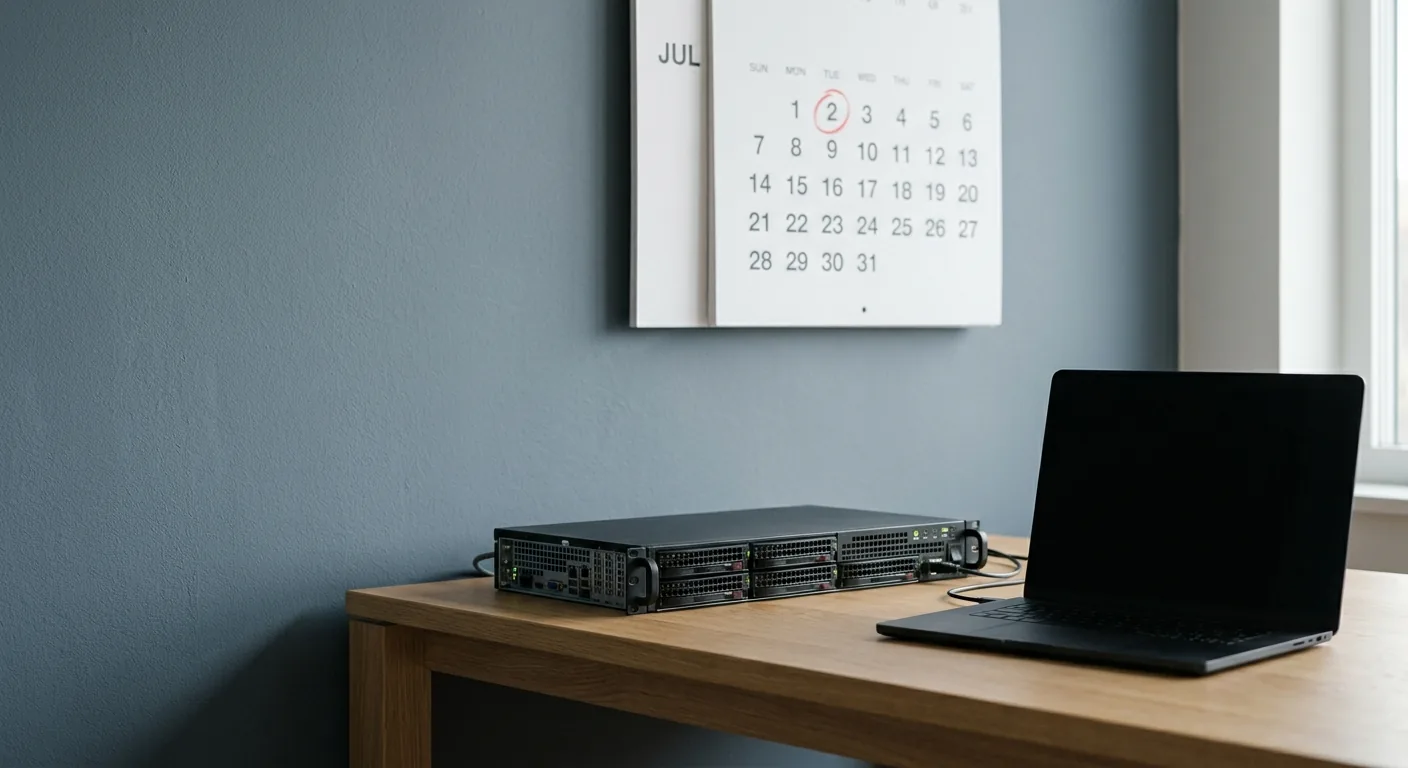
Self-hosting an open-weight model changes who controls the stack and whose law reaches your data, not whether you are automatically private, license-clean, or cheaper. With one month to EU AI Act GPAI enforcement, here is the honest board version.
As of today there is exactly one month until the EU AI Act's general-purpose-AI enforcement powers switch on (August 2). The Digital Omnibus separately pushed the heavier high-risk obligations out to December 2027 (Annex III) and August 2028 (Annex I), so this date is about general-purpose-AI enforcement and Article 50 transparency, not the full Act. A lot of boards are asking whether self-hosting an open-weight model makes them compliant. It does not, by itself. Self-hosting changes who controls the stack and whose law reaches the data. It does not make an open weight automatically private, license-clean, or cheaper, and the real sovereign choice is usually a smaller model a team can actually run on one box.
I have had the same conversation four times in two weeks, and it always starts with “if we bring the model in-house, we are covered, right?” Fair question from a founder staring at a calendar. Wrong shape, though. Today is July 2, and on August 2 the European Commission gains the power to demand documentation from providers of general-purpose AI models, evaluate them, and levy fines. That date has been fixed in law since 2024, and it is now four weeks out.
The memo below is the calm version of what to tell a board this quarter, minus the “local wins” and “the cloud is a liability” noise. Just the honest tradeoff and the three questions the board will ask anyway.
What August 2 actually turns on for general-purpose AI models
The headline that landed on executive radars: from August 2, 2026, the EU AI Act’s enforcement machinery for general-purpose AI models goes live. The obligations already existed; after that date the Commission can act on them. The fine figure is the part that makes boards sit up. As the Act’s own enforcement guidance puts it, penalties reach up to:
"3 % of their annual total worldwide turnover in the preceding financial year or EUR 15 000 000, whichever is higher."
That number is standing law, published in March, not fresh news. I flag the date on purpose: the honest thing this week is that there was no sovereignty bombshell. What is fresh is the calendar. The countdown is now inside a month, which is why the question moved from “someday” to “this board meeting.”
One clarification that saves a lot of panic. Most companies reading this are not providers of a general-purpose AI model. They are deployers. The heaviest obligations, and that fine figure, land first on the labs that ship the models. A team self-hosting Llama, Qwen, or a GLM release is a downstream user of someone else’s model, with a lighter set of duties. That distinction is the most calming thing to put in front of a nervous board, and the one most often skipped in the scary version.
Bringing a model in-house does not move a company up the obligation ladder to "model provider." It changes where the data sits and whose law reaches it. Those are different problems, and conflating them is how boards end up solving the wrong one.
What self-hosting an open-weight model really buys, and what it does not
Strip away the slideware and self-hosting buys two concrete things: control of the stack, and a say in which jurisdiction can reach the data. It does not buy automatic privacy, license cleanliness, or savings. Each has to be earned separately.
Start with the license, because “open weight” is a spectrum, not one legal status. Apache 2.0 models like Qwen and Gemma, and MIT-licensed ones like the recent GLM release and DeepSeek, permit unrestricted commercial use. Llama ships a custom license with a monthly-active-user threshold clause. Same label, different terms. The check is boring and knowable: commercial use, usage thresholds, output ownership. If a legal team has read a software license before, this is a Tuesday.
And even a model on a free and open-source license is not fully exempt under the AI Act. The provider must still adopt an EU copyright-compliance policy and publish a training-data summary, unless the model crosses the systemic-risk threshold. “We picked an open model” does not zero out obligations up the chain.
Then residency versus sovereignty, where board conversations quietly go wrong. Keeping data on a server in Frankfurt is residency: necessary, not sufficient. Under the US CLOUD Act, data held by a US-headquartered provider can be reached regardless of where the server sits. That gap is why the EU’s proposed Cloud and AI Development Act, floated in early June, sets up a four-tier sovereignty assurance framework, and why European procurement increasingly asks for infrastructure “not subject to third-country law with extraterritorial reach.”
Sovereignty is about who controls the stack and whose law reaches the data. Data residency alone is a postal address, not a guarantee.
Three questions the board will ask, and the honest answers
“Does self-hosting make us compliant by August 2?” No, and do not let anyone imply it does. Compliance is about the company’s role, use case, and documentation, not about where the GPU lives. Self-hosting supports a sovereignty and data-handling story. It is not a compliance checkbox. Deployer duties are lighter than provider duties, and the work is a data-governance exercise, not a hardware purchase.
“If we go in-house, can we just run the best open model?” Usually not the biggest one, and this is the part the demo skips. The current frontier open-weight model needs roughly eight H100 or H200-class GPUs to self-host. That is a serious cluster, not a server closet. And the hardware market is not helping at the top end: the live GPU rental trackers today show mainstream Hopper holding steady, H100 rental averaging about $3.26 an hour and up only 4% year over year, while the newest Blackwell generation climbs. As one tracker recorded this week for the B200:
"On-demand pricing has increased by about 20% since June 2025, from $5.57 to $6.67/hr per GPU."
So the sovereign choice in practice is almost never “run the leaderboard leader in-house.” It is “run a smaller, capable model that fits on one box, on a serving stack that keeps the data in the building.” A model a team can operate beats a model it can only admire.
“Are we at least saving money by owning this?” Only above a volume line, and most teams do not know where their line is. A GPU costs the same whether it serves four billion tokens a month or zero, and the raw hardware is a fraction of true cost once a DevOps salary and idle time are counted. Self-hosting flips to cheaper at sustained high volume; below that, the API is quietly winning, and the sovereignty case has to stand on data control and jurisdiction, not the GPU bill.
| Claim the board hears | Delivered automatically by self-hosting? |
|---|---|
| Data stays under our control and jurisdiction | Yes, if built for it |
| We are compliant with the AI Act | No, separate work |
| The model license is clean for our use | No, check the terms |
| It is cheaper than the API | Only above a volume line |
The 60-second version for the board
One minute in the room, say this. The August 2 enforcement date is real and one month out, but it lands hardest on model providers, and we are a deployer, so our exposure is narrower than the headlines suggest. Self-hosting an open-weight model is worth doing where data control and jurisdiction genuinely matter to our customers or regulators, because it changes who can reach our data. It does not make us automatically compliant, does not make any open license automatically safe, and does not automatically cut the bill. The right sovereign move is a model we can run on hardware we can afford, with the data-governance work done properly.
One grounding fact for the calm column: no new open-weight release worth chasing landed this week. The trackers read quiet, the freshest notable open model still weeks old, while local serving tools kept improving in the background. This is a good week to make a deliberate architecture decision rather than react to a launch.
What to watch over the next four weeks
Watch the provider side, not the deployer side. The signal that matters is how the labs behind the open weights in use respond to enforcement, since their training-data summaries and copyright policies flow into a deployer’s own diligence. Watch the EU Cloud and AI Development Act as it moves from proposal toward a timeline, since its sovereignty tiers may become the language enterprise customers use in procurement. And watch the GPU split: if the newest cards keep climbing while mainstream ones hold, the smaller-model-on-one-box path only gets more sensible.
None of this needs to be settled by Friday. It needs to be decided deliberately, once, with the board understanding what self-hosting moves and what it leaves untouched. That is a calmer place to stand than the one the countdown wants to force.
Sources
- Enforcement of Chapter V under the EU AI Act - artificialintelligenceact.eu, 2026-03-31
- H100 Cloud Pricing: Compare 47 Providers (2026) - GetDeploying, 2026-07-02
- B200 Cloud Pricing: Compare 22 Providers (2026) - GetDeploying, 2026-07-02
- The EU Cloud and AI Development Act - Lawfare, 2026-06-03
- Guidelines for providers of general-purpose AI models - European Commission, Shaping Europe's digital future, 2026-06-01
- AI Updates Today - Open Source LLM releases tracker - llm-stats.com, 2026-07-02
Written by Kinan Hamwi, Founder of Cerevisor.