Is your AI trading agent reading the consolidated tape or the direct feed?
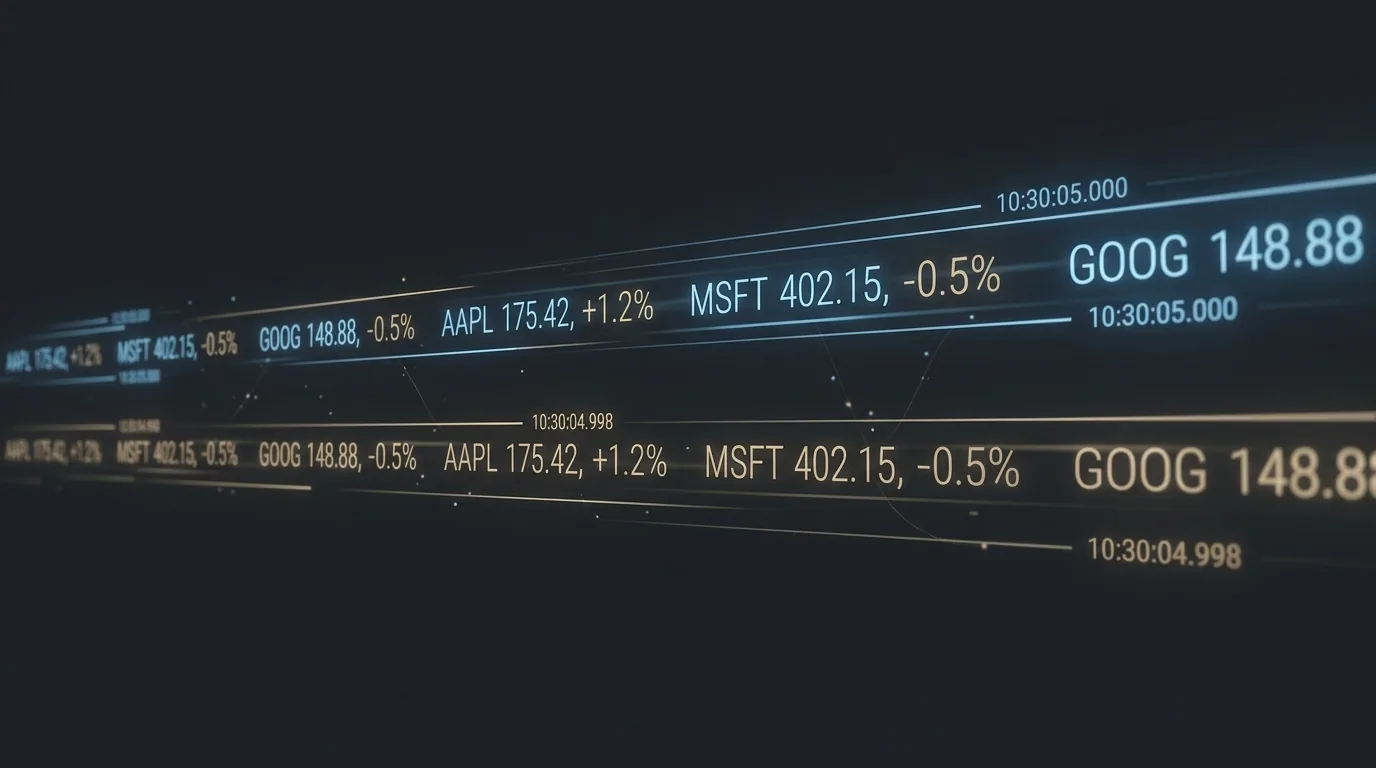
The public consolidated tape that most brokers and retail AI agents read is built a step behind the proprietary direct feeds the fast money buys. Here is how the gap works, why it never shows up in a fill report, and which of our trades can actually afford it.
The official public price feed that most brokers and retail AI agents read, the consolidated tape, is built one aggregation step behind the proprietary direct feeds that colocated firms pay for. The lag runs from tens of microseconds to a few milliseconds, it never appears in any fill report, and an agent reasoning over the slow feed is deciding on a price that has already moved. This changes execution quality and tool fit, not whether to hold.
On Thursday the chips ripped. The VanEck Semiconductor ETF (SMH) closed up 2.5%, Micron added 4.5%, and the Nasdaq Composite climbed 1.3% as oil fell, even as US-Iran tension flared again. If we had an AI agent watching that tape, it would have “seen” those prices tick higher in real time and might have fired an order into the move. Here is the part almost nobody checks: the price the agent saw was already old when it saw it. Not by much. By a beat. And on a fast day, a beat is where the money is.
How the consolidated tape falls a step behind the direct feed
Every US exchange, NYSE, Nasdaq, Cboe and the rest, publishes its quotes twice. Once into its own proprietary direct feed, sold to firms that pay to put their servers in the same building as the matching engine. And once into a shared public utility called the Securities Information Processor (the SIP, the plumbing that stitches every venue’s best quote into one official price, the national best bid and offer). The SIP has to gather quotes from all the venues, normalize them, and rebroadcast. That aggregation is a physical hop, and the hop takes time.
The numbers are stark. A firm on a direct feed sees a quote change on the order of tens of microseconds after it happens. A firm reading the same event off the consolidated tape sees it roughly a millisecond later, a ratio one study of US price discovery put above 50 to 1.
| Feed | Time to see a quote change |
|---|---|
| Exchange direct feed, colocated | single-digit to tens of microseconds |
| Consolidated tape (SIP) | around 1 millisecond, roughly 50x slower |
| Typical retail app feed | real-time SIP, or 15 minutes delayed |
To be fair, the public tape got much faster. NYSE has reported average consolidated-tape quote latency of 0.09 milliseconds in early 2018, down from 4.04 milliseconds in 2010. But faster is not first. The direct feeds got faster too, and the ordering never changed. The paid feed still sees the price before the public one does.
What Robinhood’s trading agents are actually reading
This used to be a problem only for high-frequency trading firms. Now it reaches the rest of us, because the agents arrived. Robinhood opened its platform to third-party agents this spring and extended it to round-the-clock crypto in early July. Its own description is that agents connect to a Trading MCP (Model Context Protocol, the layer that pipes market data to the agent and lets it place orders) that “feeds real-time market data to the agents.” Interactive Brokers wired Claude, ChatGPT and Grok into client portfolios the same quarter, with a human approving each order.
Here is the quiet part. “Real-time” on a retail rail means the consolidated tape, not a colocated direct feed. So the agent starts from a price that is already a beat old, then spends its own reasoning time, hundreds of milliseconds to a few seconds, deciding what to do, then waits at the human-approval gate. Every one of those delays stacks on top of a feed that was behind to begin with.
"The tech-heavy Nasdaq Composite climbed by 1.3%. Meanwhile, the S&P 500 gained 0.8%, and the Dow Jones Industrial Average put on more than 0.2%"
On a day like that, the whole index is repricing while the agent reads a snapshot that trails it. The firms on the fast feed have a name for what they harvest in that gap: the latency-arbitrage race, which researchers who quantified it estimate at around $5 billion a year globally. We sit on the other side of that trade, and we cannot see it, because none of it shows up where we would look. A fill-quality report starts its clock the instant the order is received, long after the agent read the stale price. The cost lives entirely upstream of the report.
The agent treats the price as a fact. It is an estimate with a timestamp, and on the public tape the timestamp is always a beat behind.
The gap is not an accident, and it is not going away soon. The SEC tried to close it with its 2020 Market Data Infrastructure rule and a plan for faster “competing consolidators” meant to rebuild the tape. Six years on that piece is still stalled over what the exchanges may charge, and the exchanges keep selling the fast tier alongside the slow one. Nasdaq has reported about $101 million in yearly revenue from its proprietary US equity feeds, against $120 million for its share of the consolidated tape. The slow public feed is simply the cheaper rung of a two-tier product, and it stays the default.
The one question to ask about your agent’s price feed
None of this should scare a long-term holder. If we rebalance quarterly, a one-millisecond lag on a quote is noise against a position we hold for years. It matters when the tactic is short-horizon and price-sensitive: an agent chasing a small dislocation, working a marketable order into a fast move, or trying to capture a few cents of edge that may live entirely inside a feed gap it cannot see.
Before trusting an agent's price-sensitive trade, find out what it is looking at. Ask your broker two plain things: is the quote the agent reads the real-time consolidated tape or a delayed feed, and is it the consolidated tape or a colocated direct feed. If the honest answer is "delayed" or "consolidated," size the staleness into the tactic and keep the agent off trades whose edge is thinner than the lag.
The reveal that stays with me is not that the tape is slow. It is that the agent does not know it is slow. It reads a number, treats it as the market, and acts. The most useful move we can make is to remember that the price on the screen is a report from a slightly older moment, and to decide honestly which of our trades can afford the difference.
This is editorial analysis, not investment advice. Cerevisor does not hold or recommend the named positions, and information here can become stale within hours of publication.
Sources
- Stock market today: Dow, S&P 500, Nasdaq rise as chip stocks rebound, oil prices fall - Yahoo Finance, 2026-07-09
- Understanding the Market for U.S. Equity Market Data - NYSE
- Price Discovery and the Accuracy of Consolidated Data Feeds in the U.S. Equity Markets - arXiv
- The Long and Winding Road to Market Data Reform - IEX Square Edge
- Robinhood introduces AI agent trading for crypto markets - Crypto Briefing, 2026-07-03
Written by Kinan Hamwi, Founder of Cerevisor.