How to choose a market order vs a limit order on a gap-down day
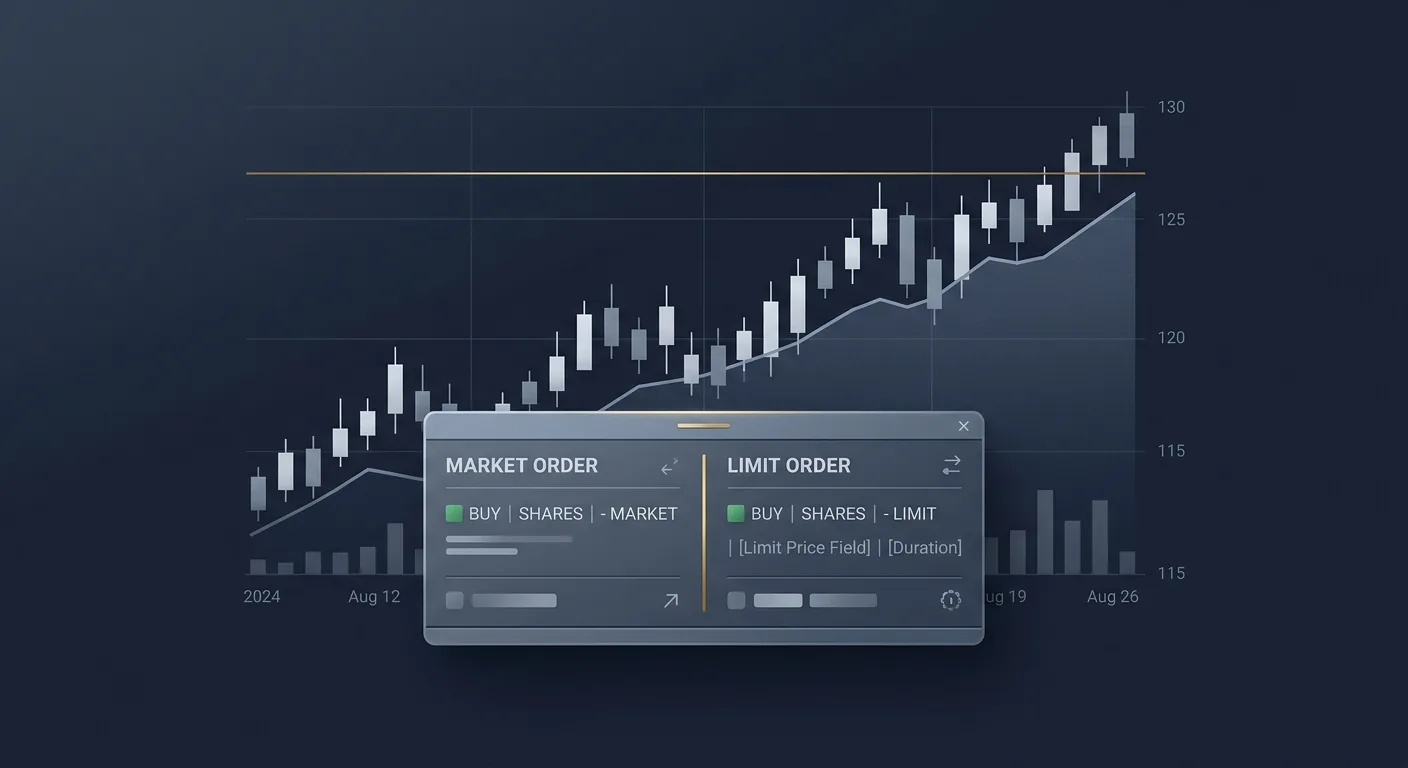
A limit order priced through the quote fills instantly like a market order but caps the worst price paid. The real entry choice is not market vs limit, it is an uncapped market order vs a price-capped marketable limit, and it decides the fill on a fast tape.
A limit order priced at or through the current quote fills right now, the same instant a market order would, but it refuses to pay past a ceiling we set. So the real decision when we want in immediately is not limit order vs market order as wait-vs-execute. It is an uncapped market order against a price-capped marketable limit, and on a fast tape that ceiling is the difference between the price on the screen and the price that actually fills.
On Wednesday, July 8, the entry button mattered more than the ticker. President Trump told the NATO summit the Iran ceasefire was over, oil spiked, and US stocks gapped lower into the news. A market order fired into that open took whatever the order book offered next, which on a jumpy tape can sit several ticks below the last print on the screen. We tend to file order types under a simple rule of thumb: a market order is for speed, a limit order is for patience. That framing is exactly where basis points leak out of an account. There is a third setting living on the same order ticket, it costs nothing to use, and most of us never reach for it on the days it matters most.
"the Dow Jones Industrial Average lost 1.51% to 52,126.81 ... the S&P 500 fell 0.91% to 7,435.81, the Nasdaq Composite declined 0.92% ... West Texas Intermediate crude jumped 7.85% to almost $76 a barrel following fresh strikes in the Middle East."
What a market order and a limit order actually guarantee
Start with the plain-English contract each order signs. The SEC’s own investor page is blunt about it. A market order “guarantees that the order will be executed, but does not guarantee the execution price.” A limit order is “an order to buy or sell a security at a specific price or better,” which means a buy limit fills at the limit price or lower and a sell limit fills at the limit price or higher. The trade every investor learns to make is the one between those two guarantees: certainty of the fill, or certainty of the price.
What gets lost is that the second guarantee has a hidden cost only when we also demand the first one. A resting limit far from the quote may never fill, and Fidelity will not even let a limit sit too far out, since a limit price more than 30% away from the last trade can be cancelled by the venue. That no-fill risk is real, and it is why a lot of us reach for the market order when we actually want to be in the position today. We treat the limit order as the slow choice. It does not have to be.
The marketable limit order, a limit that fills now but caps the price
Here is the mechanism most order tickets never explain. A buy limit priced at or above the current ask (or a sell limit at or below the current bid) is immediately executable. It crosses the spread and fills right now, the same moment a market order would, because there is resting size on the other side willing to trade at or inside the limit. The difference is that it carries a ceiling. It will sweep every share available up to the limit price and simply stop there, resting or cancelling the remainder, rather than chasing the book higher.
This is not a trick or a broker feature. It is a defined order class. The SEC’s amended execution-quality rule sorts every retail order into four buckets, and “marketable limit order” is one of them, sitting between plain market orders and non-marketable resting limits. Schwab spells out the tactic in its own order-type explainer: place a buy limit slightly above the best offer so the order stays immediately executable while still protecting against an unexpected price.
| Order | Fills now? | Worst price capped? |
|---|---|---|
| Market order | Yes | No |
| Marketable limit (limit set through the quote) | Yes | Yes |
| Plain resting limit (limit set away from the quote) | Maybe | Yes |
The choice for an immediate entry was never market vs limit. It is an uncapped market order vs a marketable limit that fills just as fast and adds a ceiling for free. The market order is the one with no seatbelt.
The order type an AI agent reaches for by default
This is where the agentic broker wave makes an old lesson urgent again. On Robinhood, Interactive Brokers, and eToro, a connected agent can place orders “with the different available order types,” and the human sign-off step approves the submission, not the outcome. If an agent’s default reasoning maps “get in now” to a market order, every entry it fires on a volatile session inherits the full through-the-book move, and the approval screen will not flag it, because a clean market order is not an error. Robinhood says as much in its own terms: agents “can make errors, misinterpret instructions, act on incomplete or outdated information,” and the account holder remains “responsible for reviewing account activity.”
A market order tells the book to fill at any price available. On a calm day that is a rounding error. On a gap-down day it is the trade.
The tool-fit question is narrow and answerable: does the order schema an agent uses expose a limit price, and does its house style set one? An agent that can only submit market orders is fast in exactly the wrong way.
Setting a marketable limit the way a careful trader would
-
Make the marketable limit the default "now" order
For an immediate buy, set the limit a defined slice above the current ask (a sell, below the bid). It fills at once and caps the worst price in one step.
-
Size the cap to the spread, not a round number
A penny-wide, deeply liquid name needs a tiny cushion. A wide-spread small cap or a gapping open needs more room, or it will miss.
-
Keep the plain market order for calm, deep books
When the spread is one cent and size is stacked on both sides, the ceiling rarely binds and the market order is fine. Reserve it for that case.
-
Audit the agent's order schema once
Confirm the agent can pass a limit price and that its instructions tell it to. If it only fires market orders, that is the single setting worth changing.
-
Read the fill against the quote, not the confirmation
Compare the price we got to the quote at the moment of the decision. That gap, not the confirmation screen, is what the order type actually cost.
The quiet irony is that the button labelled for safety, the one that just gets us in, is the only one with no ceiling, and the ceiling is free to add. On most sessions the two fills land on top of each other and none of this shows up. The value of the cap is entirely concentrated in the handful of days a year when the tape gaps, which are precisely the days we are most tempted to stab the fastest button on the ticket. What would change in a portfolio if the default entry were the capped one, and the uncapped market order became the exception we chose on purpose?
This is editorial analysis, not investment advice. Cerevisor does not hold or recommend the named positions, and information here can become stale within hours of publication.
Sources
- Stock Market Today, July 8: Stocks Slide and Dow Drops 1.5% as Middle East Tensions Spike - The Motley Fool, 2026-07-08
- Stock market today: Nasdaq rises, Dow and S&P 500 retreat as oil prices climb on renewed US-Iran tensions - Yahoo Finance, 2026-07-08
- Types of Orders - SEC Investor.gov
- Order Types and Conditions (Help) - Fidelity
- 3 Order Types: Market, Limit and Stop Orders - Charles Schwab
- Frequently Asked Questions: Rule 605 of Regulation NMS (April 1, 2026) - U.S. Securities and Exchange Commission, 2026-04-01
- Agentic Trading overview - Robinhood
Written by Kinan Hamwi, Founder of Cerevisor.