Your AI agent approves every buy. Who approves the forced sale in a margin call?
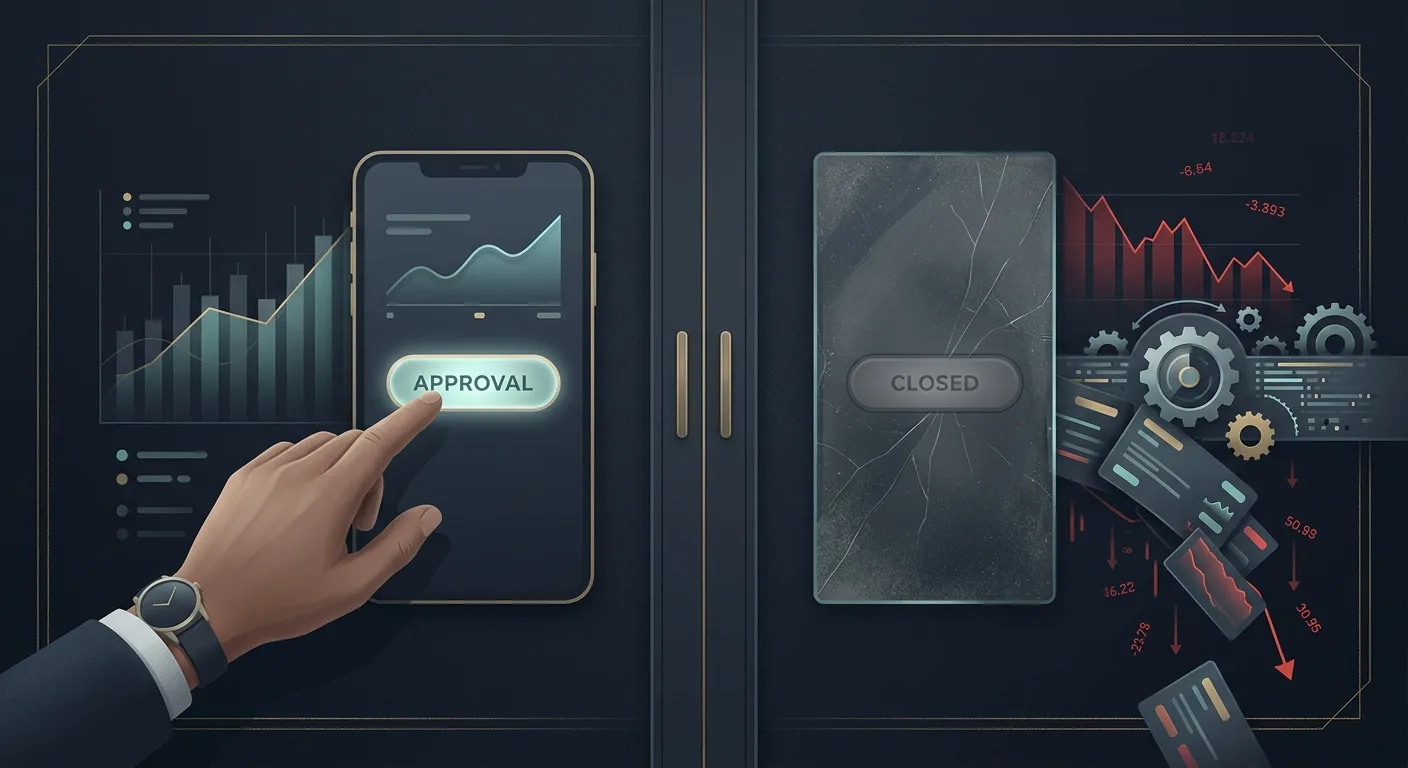
The 2026 bring-your-own-agent brokers make you approve every opening trade, which feels like control. When a margin call is not met, the broker picks which positions to sell, in what order, at market, with no notice, and the agent has no say. Here is the forced-liquidation mechanism and why the approval gate does not reach it.
The new bring-your-own-agent brokers ask us to approve every position the agent opens, which reads as control. It is not control over the exit that matters most. When a margin call goes unmet, the broker chooses which holdings to sell, in what order, at market, with no notice, and the agent that opened the book has no standing to defend it. The approval gate governs buying, not the broker's forced selling, and with margin debt at a record 1.42 trillion dollars that gap is worth understanding before the market tests it.
There is a screen in the Interactive Brokers agent flow, and one in Robinhood’s, that asks us to approve each trade an AI agent wants to place. It shows the order and makes the arrangement feel like we are still holding the wheel. Margin debt just hit a record 1.42 trillion dollars in May, up 8.5 percent in a month and 53.7 percent on the year, per FINRA data reported on June 28. The investor net credit balance, cash minus borrowings, sits at a record low of negative 991.7 billion dollars. So it is a reasonable moment to ask what that approval button actually covers.
The belief that the approve-each-trade button keeps us in control
The belief runs like this. If the agent cannot place one order without me tapping approve, nothing happens in my account that I did not sanction, and my positions are mine because I opened each one on purpose. The broker interfaces are built to tell exactly that story: IBKR routes agent orders through an instruction-and-review step, Robinhood shows a trade preview before anything reaches the market. The design intent is real and the reassurance is not manufactured.
The belief is right about one direction and silent about the other. The approval gate genuinely governs order entry: the agent proposes, we dispose, no opening trade jumps that fence. It was built for the risk the brokers worried about most, an autonomous system firing orders on its own authority. What it was never designed to touch is the other kind of sale, the one the broker itself initiates when the account no longer holds enough equity to back its borrowed positions. That sale is not the agent’s order and not ours. It is the broker’s, on rules that predate agents by decades.
What actually happens when a margin call goes unmet
When account equity falls below the maintenance requirement and the call is not met, the broker liquidates. Not the agent, not us. And the broker’s own disclosure is unusually blunt about how much say we get.
"Interactive Brokers generally will liquidate positions in accounts in order to satisfy margin requirements without prior notice to customers and without an opportunity to choose the positions to be liquidated or the timing or order of liquidation."
Read that twice. No prior notice. No choice of positions. No choice of timing. No choice of order. The same broker adds that it generally will not issue a courtesy margin call at all and can sell immediately if an account is short of margin. Despite the phrase “margin call,” a broker is not legally required to phone anyone before it starts selling, and in fast conditions it will not.
The approval gate is a permission on the way in. Forced liquidation is a broker action on the way out. Two different doors, and only one has our hand on the handle.
The one lever the broker offers is weaker than it looks. IBKR lets a client flag a position “Liquidate Last,” a request to sell it last in a deficit. It sounds like control over the exit order. It is not binding: the broker honors it on a best-efforts basis and retains the right to determine the assets liquidated, the amount, and the order and manner of liquidation. The single control we are handed over the forced close is a preference the broker may ignore.
And the forced close is an automated process that can cost more than the raw market move. In 2026 Interactive Brokers agreed to pay 5 million dollars to settle a class action alleging its automated liquidation software was negligently designed and made customers lose more than necessary, by selling outside a defined internal price corridor, for liquidations running from December 2013 to July 2025. The machine that sells us out is not infallible, and when it errs, it errs at market.
Why the approve-each-trade story keeps holding up anyway
The myth survives because most of us have never seen the second door open. Markets just closed the best quarter since 2020, with the S&P 500 up 0.79 percent on June 30 to 7,449.36 and the Nasdaq Composite up 1.52 percent, a bounce built partly on short-covering into quarter-end. In a rising tape, maintenance margin never gets tested, the forced-close machinery never runs, and the approval button is the only mechanism we ever touch, so it comes to stand in for the whole of our control. Buying and forced selling were always different systems. The rising market kept the second one offstage.
The reason it matters now is in the leverage numbers. Leveraged funds concentrated in technology, AI, and semiconductors have swelled to roughly 179 billion dollars, about 85 percent of them in those three sectors. A record negative net credit balance means the average margin account carries more borrowed exposure and less cash cushion than at any point on record, including 2021. That is the distance between the equity we hold and the positions we owe, and it is the distance the forced-close machinery exists to erase in a hurry.
We approve the way in. The broker decides the way out. In a calm market we only ever see the first door, so we mistake it for the whole house.
What might make this read too alarmist
The honest counter-case is that most people running a personal agent are not on heavy margin, and forced liquidation only reaches accounts that borrowed. On unlevered positions the maintenance requirement is not in play and none of this fires. The risk surface here is a function of leverage, not of the agent, and an agent on a cash account inherits none of it.
The nuance is that an agent quietly changes how easy it is to drift into leverage without deciding to. One rebalancing toward a target, adding on strength, or holding a margin-eligible book across a gap-down can carry an account toward the maintenance line through a series of individually approved trades, none of which felt like a leverage decision. We approved each step. We did not approve the sum, and the sum is what the broker measures when it decides to sell.
Reading this as a risk surface, not a reason to sell
The move is not to fear the agent. It is to price the exit we do not control. Read the broker’s liquidation disclosure the way you would read a fund’s redemption terms, because that is what it is. Check whether the account is even on margin, keep a cash buffer above maintenance that an approved trade cannot erase, and treat any “Liquidate Last” flag as a preference, not a guarantee.
The question I keep returning to is quieter than a crash. It is what happens the first time an agent, having dutifully asked us to approve every purchase, watches the broker sell half of them in an order it did not choose, while we are asleep. The approval log will show every buy we sanctioned and have nothing to say about the sale that mattered most.
This is editorial analysis, not investment advice. Cerevisor does not hold or recommend the named positions, and information here can become stale within hours of publication.
Sources
- Leverage driving US stock rally sparks growing unease among market watchers - Crypto Briefing, 2026-06-28
- Stock Market Today (June 30, 2026): U.S. indexes wrap best quarter since 2020 - TheStreet, 2026-06-30
- Disclosure of Risks of Margin Trading / Margin Requirements - Interactive Brokers LLC
- Liquidate Last (glossary) - Interactive Brokers Campus
- Interactive Brokers $5M Settlement Over Automated Margin Liquidation - AllAboutLawyer
Written by Kinan Hamwi, Founder of Cerevisor.