Should we trust the new odd-lot prices our trading agents can now see?
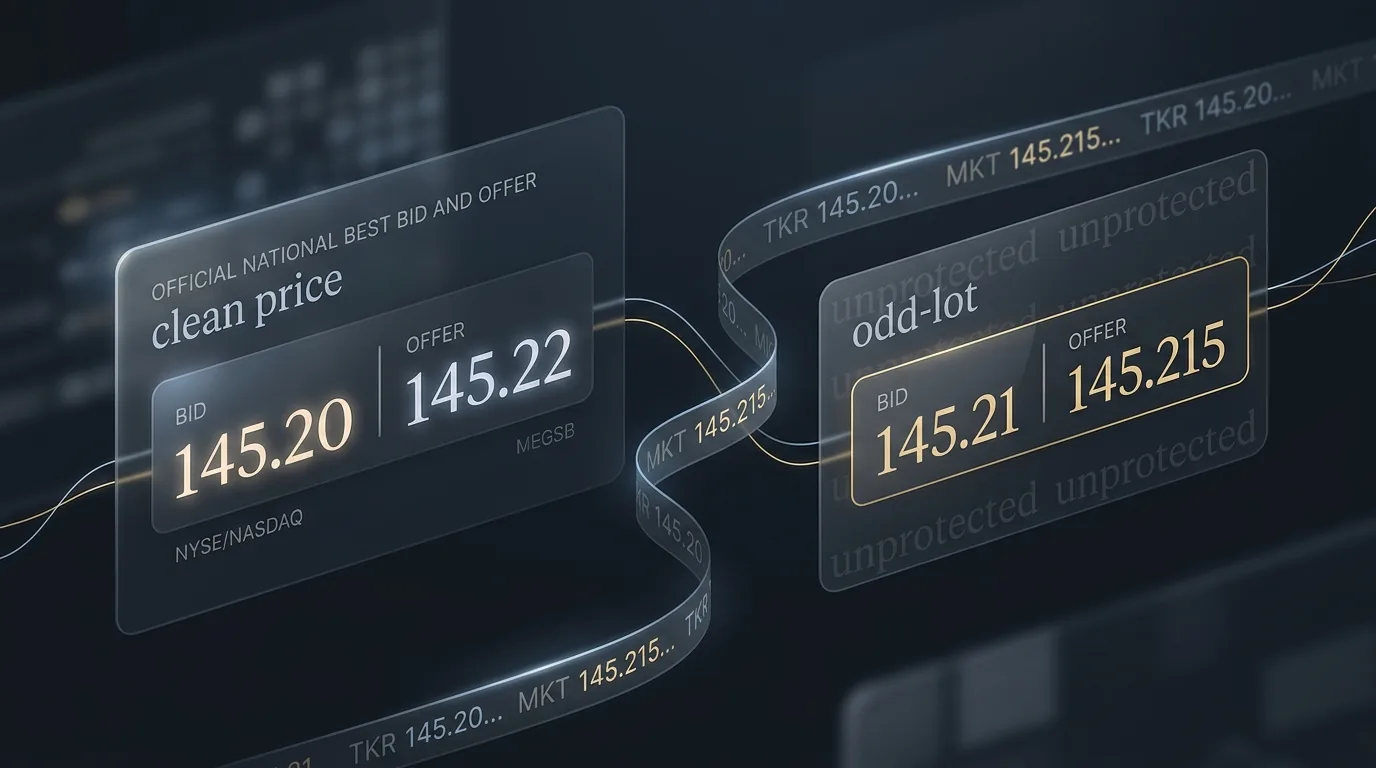
On May 1, 2026 the public price tape began carrying odd-lot quotes through a new field called the Best Odd-Lot Bid and Offer. They are now visible to us and to any trading agent reading the feed, but they are not protected, so no broker has to route an order to them. For holders of $200-plus stocks, where most orders are odd lots, that gap between visible and protected is the whole decision.
On May 1, 2026 the public price tape started carrying odd-lot quotes for the first time, through a new field called the Best Odd-Lot Bid and Offer. The mechanism worth knowing is that those prices are now visible to us and to any trading agent reading the feed, but they are not protected, so no broker is required to route an order to them. For anyone holding stocks above $200 a share, where most orders are odd lots, the gap between visible and protected is the whole decision.
Robinhood told the market on May 30 that it now lets a language model trade through a connection standard called the Model Context Protocol, with roughly $350 billion in platform assets behind it and an average account near $12,000. Run that against a stock trading north of $200 a share and the typical order is a handful of shares. That is an odd lot, an order smaller than the traditional 100-share round lot. So here is the decision in front of us this month: a fresh set of odd-lot prices just appeared on the public feed our brokers and our agents read. Can we trust them, and what do they actually change?
For the entire history of the consolidated tape, quotes for fewer than 100 shares were collected by exchanges and then left off the public feed. They never counted toward the official best price visible across exchanges, the figure regulators call the national best bid and offer. Retail saw round-lot prices only. Odd lots, meanwhile, quietly grew into most of the market.
"Odd lots accounting for 70% of the market, up from 20% in 2005."
On May 1, 2026, under the SEC’s Market Data Infrastructure rule, the processors that publish the consolidated tape began disseminating the Best Odd-Lot Bid and Offer: the best odd-lot bid sitting above the national best bid, and the best odd-lot offer sitting below the national best offer. In the same package, the definition of a round lot stopped being a flat 100 shares and went variable by price.
| Stock price | Shares in a round lot |
|---|---|
| Under $250 | 100 |
| $250 to $1,000 | 40 |
| $1,000 to $10,000 | 10 |
| Above $10,000 | 1 |
Here is the part that does the deciding. Visibility is not protection. The odd-lot prices now on the tape are informational. They are not protected quotes, which means no broker carries any obligation to route an order to the better odd-lot price the way it must when the national best bid and offer is in play. An agent reading the feed can now see an odd-lot offer a cent better, point straight at it, and still be filled at the worse round-lot price, with nothing broken and no rule violated. The visibility is also only top-of-book: the tape processors won a temporary exemption, so anything beyond each venue’s single best odd-lot quote stays dark until May 2028. And speed is not the missing piece, since the consolidated tape now clears in under 20 microseconds. The gap is the rulebook, not the wiring.
The new feed lets us see a better odd-lot price. It does not let us demand a fill there. For high-priced stocks, where most of our orders are odd lots, that is the difference between a transparency win and an execution win, and only the first one actually arrived this month.
-
Read the disclosure we already get
Open the routing and execution-quality disclosure our broker publishes and look for any mention of odd-lot or Best Odd-Lot handling.
-
Price the odd lot we can now see
On stocks above $200, use a limit order set at the odd-lot level on the feed rather than trusting a market order to find it.
-
Treat the quote as information, not a promise
A better odd-lot price is a data point, since nothing obliges a fill there.
-
Ask what feed the agent reads
Check whether an agent tool consumes the consolidated public feed or a direct exchange feed, because they carry different pictures.
-
Mark the calendar
Note May 2028, when the deeper odd-lot book is due to become public.
What strikes me is that we spent years asking for odd-lot prices on the public tape, got them this month, and the rulebook that decides our fills did not move an inch. The interesting question is whether seeing a better price we cannot demand makes us sharper traders, or just more aware of what we were already leaving on the table.
This is editorial analysis, not investment advice. Cerevisor does not hold or recommend the named positions, and information here can become stale within hours of publication.
Sources
- Robinhood Markets Bets on Agentic AI Trading as Assets Climb to $350 Billion - Yahoo Finance (Bloomberg), 2026-05-30
- Fractional Shares, Odd Lots, and the Overhaul of U.S. Market Data: What Data Teams Need to Know - FactSet Insight, 2026-04-13
- Round-Lots, Odd-Lots Push Forward, while SEC Delays Tick Size and Access Fees - FlexTrade, 2025-11-04
- SEC Grants Request for Exemption Related to Dissemination of Odd-Lot Depth of Book - PR Newswire (SIP Operating Committees), 2026-01-22
Written by Kinan Hamwi, Founder of Cerevisor.