Is post-earnings announcement drift dead, or did AI just push it where we cannot reach it?
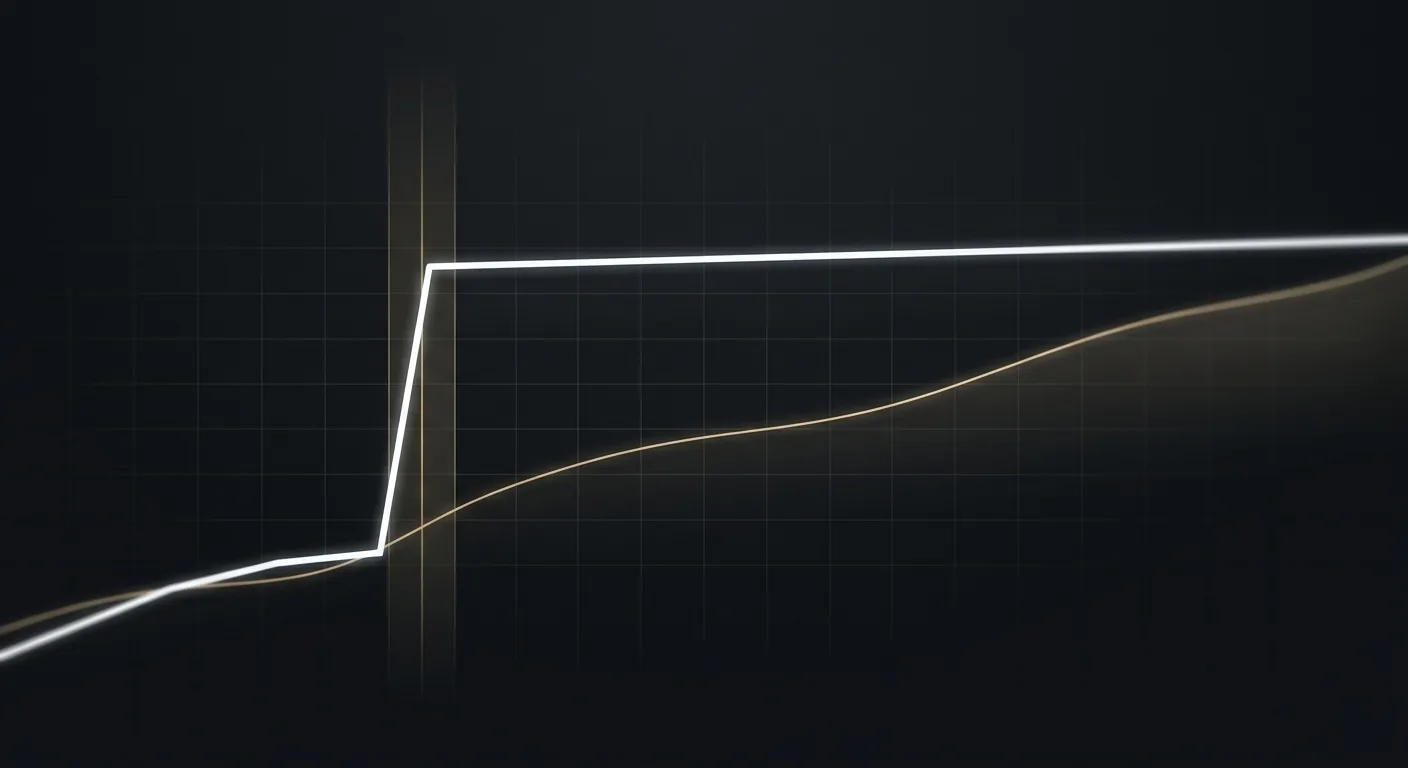
Post-earnings-announcement drift, the oldest tradeable anomaly, looks dead in liquid large caps and alive in the smallest stocks. The reason is a mechanism, not a coincidence: AI compressed the reading-speed slice of the drift and left the diffusion-and-arbitrage-cost slice standing where capital cannot cheaply follow.
Post-earnings-announcement drift, the tendency of a stock to keep moving in the direction of an earnings surprise for weeks, looks dead in liquid large caps and alive in the smallest names. That split is not noise, it is a mechanism: AI compressed the part of the drift that came from reading the number slowly, and left standing the part that comes from the market revising slowly and from the cost of trading thin stocks. The edge did not vanish. It relocated to the corner we can least afford to reach.
The Q2 2026 reporting season starts in earnest in about ten days, when the large banks report on July 14 and the first mega-caps follow later in the month. FactSet expects the S&P 500 to post year-over-year earnings growth of 23.3% for the quarter, the second straight quarter above 20%. Last quarter, 80.6% of reporting companies beat the earnings estimate. Hold those two numbers together and something obvious falls out: a beat is now the base case, not a surprise.
Which drags an old argument back into the light. Post-earnings announcement drift is the oldest tradeable anomaly we have, first documented by Ball and Brown in 1968 and formalized by Bernard and Thomas in 1989. In 2022 a University of Toronto researcher, Charles Martineau, published a paper titled “Rest in Peace Post-Earnings Announcement Drift.” Then in 2025 two more papers, accepted for publication, argued the drift is alive and well. Both camps are reading the same market. So which is it, and what changed.
What “Rest in Peace Post-Earnings Announcement Drift” actually claimed
Start with the classic edge. Across decades of academic work, buying the biggest positive earnings surprises and shorting the biggest negative ones earned roughly 2.6% to 9.4% in quarterly abnormal return, meaning return beyond what the broad market did, as prices kept drifting for weeks after the report rather than snapping to fair value at once.
Martineau’s 2022 claim was specific and it was not hand-waving. The drift began fading from non-microcap stocks in 2001 and had completely disappeared from them by 2006, right after decimal pricing and the high-frequency-trading buildout made trading against a mispricing cheaper and faster. The 2025 counter-papers say the drift is still there. The two findings only look contradictory until you notice the single research choice that flips the result: whether the smallest stocks are in the sample.
The UCLA Anderson Review walked through the arithmetic this January. When the drift factor is measured across all stocks, its t-statistic, the standard test of whether a result is signal or noise where roughly 2 is the usual bar, comes in at 2.18, barely clearing the line. Drop the microcaps and it falls to 1.43, below the threshold. Microcaps are about 3% of total stock-market value, and they carry most of the statistical evidence that the drift exists at all.
| Sample | Drift-factor t-statistic | Verdict at the ~2.0 bar |
|---|---|---|
| All stocks (microcaps included) | 2.18 | Barely real |
| Excluding microcaps (~3% of market value) | 1.43 | Below significance |
Why a millisecond read does not close a multi-week drift
Here is the mechanism, because the mechanism is the whole story. When a company reports a surprise, prices do not leap straight to the new fair value. Information diffuses into the price gradually as more holders update their view, so the cumulative return keeps drifting in the surprise’s direction for as long as roughly 60 trading days. Two forces hold it open. The first is under-reaction: people, and the models people run, revise their estimates slowly. The second is limits to arbitrage: the practical cost and risk of putting on the trade that would close the gap.
An agent reading the earnings line in milliseconds attacks only the first slice, the reading-speed slice. It does nothing about the diffusion slice, because that is other holders revising over days. And it cannot lower the cost of trading a stock that barely trades. So the drift splits by terrain. Where a name is large, liquid, and the surprise is a clean beat or miss on the headline number, arbitrage capital floods in and flattens the drift within hours. Where a name is small, thinly covered, or the surprise is buried in guidance language or a footnote no scanner parses cleanly, the cost of trading against it stays high and the drift survives.
AI killed the part of the drift you could read your way into. It could not touch the part that lives in slow revision and in the cost of trading small, complex names, so the anomaly concentrated exactly where it is hardest to harvest.
The drift did not die. It moved to the one corner of the market where the cost of chasing it is higher than the edge itself.
An edge that survives only where capital cannot follow
The honest version, then, is not “the drift is dead” and not “the drift is alive.” It is that the liquid, scalable, individual-investor-friendly version of post-earnings drift is mostly gone, and the version that remains lives where we would pay the most to reach it. In the names we can trade at size, the number is anticipated long before it lands. Companies telegraph the direction, agents price the telegraph, and by report day the large-cap surprise is small and the drift is thin.
The telegraphing is not a theory. It is in the guidance data for the very season about to start.
"The percentage of S&P 500 companies issuing positive EPS guidance for Q2 2026 is 57% (63 out of 111), which is also well above the 5-year average of 41%."
When 57% of the companies that bother to guide are guiding up, against a five-year norm of 41%, the earnings per share number (EPS, the per-share profit figure) is close to pre-announced. A surprise that everyone saw coming is not much of a surprise, and a beat that was guided into existence does not leave a lot of drift behind it in a stock a thousand agents are already pricing.
How to read an AI earnings-surprise backtest before you believe it
This is where the peer-to-peer part matters, because the pitch is everywhere now. When a product or a backtest shows fat returns from trading the earnings surprise, three questions decide whether it is real for people running real money. First, does the return lean on microcaps we could not buy in size without pushing the price against ourselves. Second, is it net of the cost of trading those thin names, or is it a gross number that quietly ignores them. Third, does the surprise it measures capture the simple headline beat, already arbitraged flat, or the complex buried surprise where the residual actually lives and where a text scanner is least reliable.
And there is a genuine peer-of-mind read in this. If our large-cap winners stopped drifting obligingly upward after a clean beat, that is not us missing a trade. That is the anomaly being flattened in exactly the names we can trade, which is the price of a market where more than three-quarters of the volume is running similar models on similar data.
The uncomfortable version is that an edge which only survives where it cannot be cheaply harvested is barely an edge at all. It is closer to a fee the market pays for holding what is hard to sell. The drift is still there, measurable and real and mostly out of reach. What I keep turning over is whether the next wave of agents, pointed squarely at the small and the illiquid, closes that last corner too, or whether the cost of trading it turns out to be the one moat that does not fall to a faster read.
This is editorial analysis, not investment advice. Cerevisor does not hold or recommend the named positions, and information here can become stale within hours of publication.
Sources
- S&P 500 Earnings Season Preview: Q2 2026 - FactSet Insight, 2026-07-02
- Is Post-Earnings Announcement Drift a Thing? Again? - UCLA Anderson Review, 2026-01-21
- Stock Market News for July 1, 2026 - Zacks via Yahoo Finance, 2026-07-01
- Post-Earnings Announcement Effect - Quantpedia
- AI Trading Crowding Erases Quant Edge, 2026 - Pomegra, 2026-06-04
Written by Kinan Hamwi, Founder of Cerevisor.