Securities financing transactions: the market's collateral plumbing, and the agents moving into it
Securities financing transactions are the repo, lending, buy-sell-back and margin loans that quietly fund the market. European repo alone runs to EUR 13.7 trillion, most of it built on collateral re-used down a chain where the haircut is the only brake, and that brake is often set to zero. Here is how the plumbing actually works, and why the automation moving into it is worth watching.
Securities financing transactions are the four kinds of secured short-term loan (repo, securities lending, buy-sell-backs and margin lending) that fund the market between trades. European repo alone reached a record EUR 13.7 trillion, and roughly $16 trillion of government-bond repo sits under the system. The mechanism that makes it work is collateral re-use: the same bond is pledged down a chain, with the haircut as the only brake on how much leverage each hop adds, and the Financial Stability Board reports about 70% of the non-cleared segment runs with no haircut at all. This is a phone-and-spreadsheet market, and it is exactly the kind of workflow AI agents are now being pointed at.
In February the Financial Stability Board, the international body that watches the pipes between big banks for early signs of stress, published a number almost no market-news desk led with. Around $16 trillion in repurchase agreements backed by government bonds were outstanding at the end of 2024, roughly 80% of all the repo in the system. That is not a niche corner. It is one of the largest pools of money in the world by the cash that moves through it every day, and it sits directly underneath the assets we hold, funding the dealers who make our markets and the funds that trade against us.
It has a name we almost never say out loud: securities financing transactions. If we have ever wondered how a hedge fund borrows the cash to run a position several times the size of its own capital, or how idle shares earn a fee while their owner sleeps, the answer lives inside this one dry phrase. It is the plumbing. It is worth reading before the water starts running through agents.
Four kinds of secured loan hide inside one dry phrase
“Securities financing transactions” is a regulatory umbrella that Europe coined. Under Regulation (EU) 2015/2365, the rulebook the market calls SFTR (the Securities Financing Transactions Regulation, the post-2008 law that forced this once-invisible market to report every deal so supervisors could finally watch collateral being re-used), the category holds exactly four instruments. They look different on a desk but do the same economic job: turn securities into short-term funding, or turn cash into a yield on securities.
| Instrument | What happens |
|---|---|
| Repurchase agreement (repo) | Sell a bond for cash now, agree to buy it back later at a slightly higher price. The price gap is the interest. |
| Securities lending | Lend a security to someone who needs it (usually to sell short), take collateral and a fee in return. |
| Buy-sell-back | Economically a repo, but documented as two separate outright trades rather than one financing contract. |
| Margin lending | A prime broker extends credit to buy or carry securities, secured by the securities themselves. |
The scale showed up the day the market first had to report itself. When SFTR reporting went live on 11 July 2020, firms filed 1,435,727 transactions in the first week alone, carrying a combined cash value of EUR 14.3 trillion and a collateral value of EUR 17.8 trillion. Repo and its close cousin the buy-sell-back were 398,006 of those reports, under 28% by count but 94.7% of the cash. So the category is mostly repo by value, with securities lending and margin lending filling the rest. We have already walked through securities lending from the share-holder’s side, in how the borrow fee on idle shares gets split before it reaches you; this piece is about the whole category and the one mechanism that ties it together.
How one bond can fund several positions before lunch
Here is the mechanism, stripped to the plumbing, because it is the part that most investors never see and the part that decides how much leverage the system carries.
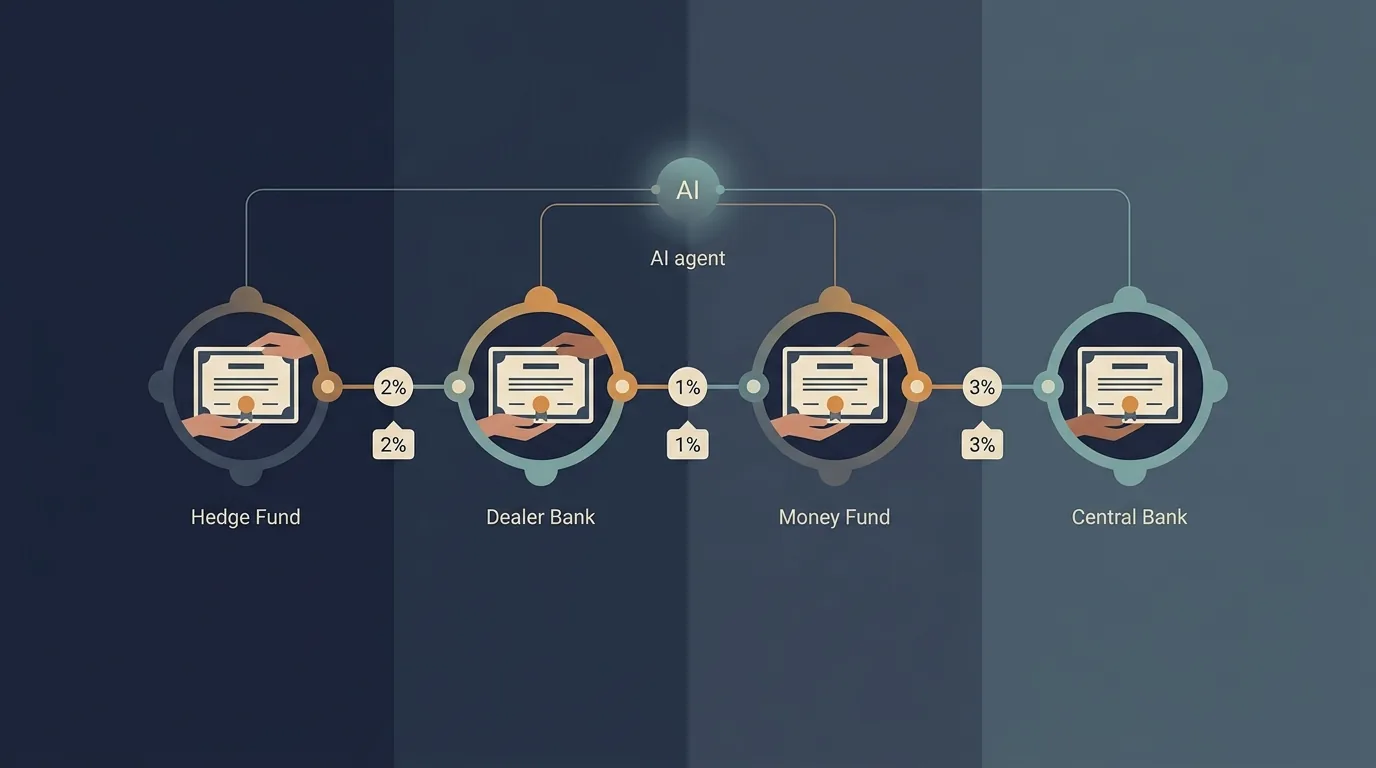
Start with a single government bond owned by a hedge fund. The fund pledges it in a repo to a dealer and receives cash. The dealer now holds the bond as collateral, and it does not sit in a vault. The dealer re-uses that same bond, pledging it onward in its own repo to a money fund to raise cash, or delivering it to settle a short somewhere else. The money fund may re-use it again. One bond, several transactions, each one a real loan of real cash, all secured by the same piece of paper travelling down a chain. This is collateral re-use, or rehypothecation, and it is the engine that lets a modest stock of high-quality bonds support a very large stock of funding.
The only brake on the chain is the haircut. A haircut is the discount a lender applies to collateral: pledge a bond marked at 100 and borrow 98 against it, and the 2% haircut means each hop loses a sliver of borrowing power, so the chain naturally shortens. Set the haircut to zero and that brake is gone. The same bond supports its full value at every hop, and the length of the chain is limited only by how many counterparties are willing to keep passing it along.
~$16 trillion in government-bond repo outstanding at end-2024, about 80% of all repo, most of it in a segment where the haircut brake is frequently set to zero.
That is not a hypothetical worry. It is what the Financial Stability Board went out of its way to flag this February.
"Approximately 70% of activity in the non-centrally cleared segment operates with zero haircuts and there are high levels of collateral rehypothecation."
Read that slowly. In the bilateral part of this market, most of the trades apply no haircut, and the collateral gets re-used heavily on top of that. The chain has no built-in shortener. That is the honest reason hedge-fund borrowing in repo has climbed toward the trillions: the plumbing is efficient precisely because the brake is optional.
EUR 13.7 trillion in Europe, and the fees that ride on top
The size numbers make the point that this is where a surprising amount of the market’s money actually lives. The International Capital Market Association, whose repo committee runs the industry’s model contracts, put European repo at a record EUR 13.7 trillion in its fiftieth semi-annual survey, up from EUR 12.4 trillion a year earlier, an 11.9% jump. And because the survey covers only a sample of dealers, that figure is a floor, not a ceiling.
The securities-lending corner is smaller but paid extraordinarily well in 2025. Global securities lending generated a record $15.3 billion in revenue, up 26% year on year, with loan balances topping $4 trillion for the first time, according to EquiLend’s DataLend. None of that revenue shows up in any fill report or execution-quality statistic, because those only describe trades. Financing income is the yield on holding and lending, and it is one of the largest revenue lines in the market that retail investors are least likely to have on their radar.
Repo and lending are where a large share of the market's money quietly lives, and almost none of it appears in the fill reports we actually read.
What an agent does that a collateral trader used to do by phone
Here is why any of this belongs in a letter about agentic markets. Securities finance is, still, a strikingly manual business. Collateral trades are negotiated over the phone and by chat, priced against relationships as much as screens, and reconciled across spreadsheets. That profile (repetitive, judgment-light, rule-heavy, high-volume) is exactly the shape of work agents are being built to absorb.
Industry analysis from Broadridge describes AI taking over 70% to 80% of manual workflows in the liquid part of securities finance, and, in the less liquid corners, handling the request-for-quote traffic (the back-and-forth where a desk asks several counterparties to price a specific piece of collateral), the negotiation support, the documentation review and the compliance checks. The more interesting claim is that agents can allocate collateral dynamically and watch liquidation risk in real time. Collateral optimization is, at heart, an assignment problem: given every bond a firm holds and every obligation it has to cover, which piece goes where, at which haircut, to minimize total funding cost. That is a problem a well-instrumented agent solves better than a trader with a phone and a good memory.
The mechanism that makes securities finance efficient, collateral re-use down a chain, is also an optimization problem. Optimization problems are what agents are for. So the same automation wave that is reaching execution and research is now reaching the layer that decides how far, and how fast, a single bond travels.
What would have to be true for this read to be wrong
The steelman matters here, because it is easy to over-read a plumbing story. Two things could make this less consequential than it sounds.
First, visibility is lopsided. SFTR gave Europe a live feed of who is financing what against which collateral. The United States has no equivalent transaction-reporting regime for securities financing, so for the largest bond market on earth the chain is still mostly dark, and a mechanism no one measures is hard to manage, automated or not. Second, agents optimizing collateral could simply make an already-efficient market marginally more efficient, shaving basis points off funding costs without changing the system’s behavior at all.
The counter to both is synchronization. If every desk’s agent optimizes collateral against similar data with similar objectives, they will tend to re-use the same bonds in the same direction at the same moments. In a segment where about 70% of trades carry no haircut, a brake that was already optional becomes a brake that many participants release together. The risk was never that agents would re-use collateral. It is that they would all decide to re-use it the same way, on the same afternoon.
I keep coming back to one quiet fact about this market. It works because the collateral never stops moving, and the haircut is the one thing that decides how fast. For decades that decision sat with people who could feel when a chain was getting too long. The question worth sitting with is what happens to that instinct when the thing setting the pace is an agent optimizing for funding cost, to which a longer chain and a shorter one look like nothing more than two numbers.
This is editorial analysis, not investment advice. Cerevisor does not hold or recommend the named positions, and information here can become stale within hours of publication.
Sources
- Securities financing transactions (SFTs) - European Commission
- SFTR reporting regime sees successful first day - European Securities and Markets Authority (ESMA), 2020-07-14
- ICMA's 50th European Repo Market Survey: Market Growth Continues, Reaching EUR 13.7 Trillion - International Capital Market Association (ICMA), 2026-03-26
- Vulnerabilities in Government Bond-backed Repo Markets - Financial Stability Board (FSB), 2026-02-04
- Securities Lending Revenue soars to all-time highs of $15.3 Billion - EquiLend Data & Analytics (DataLend), 2026-01-08
- What are the Applications for Artificial Intelligence in Securities Finance and Collateral Management? - Broadridge
Written by Kinan Hamwi, Founder of Cerevisor.