The AI Bet Is Moving Downstream: This Week's Signals for Series A Founders
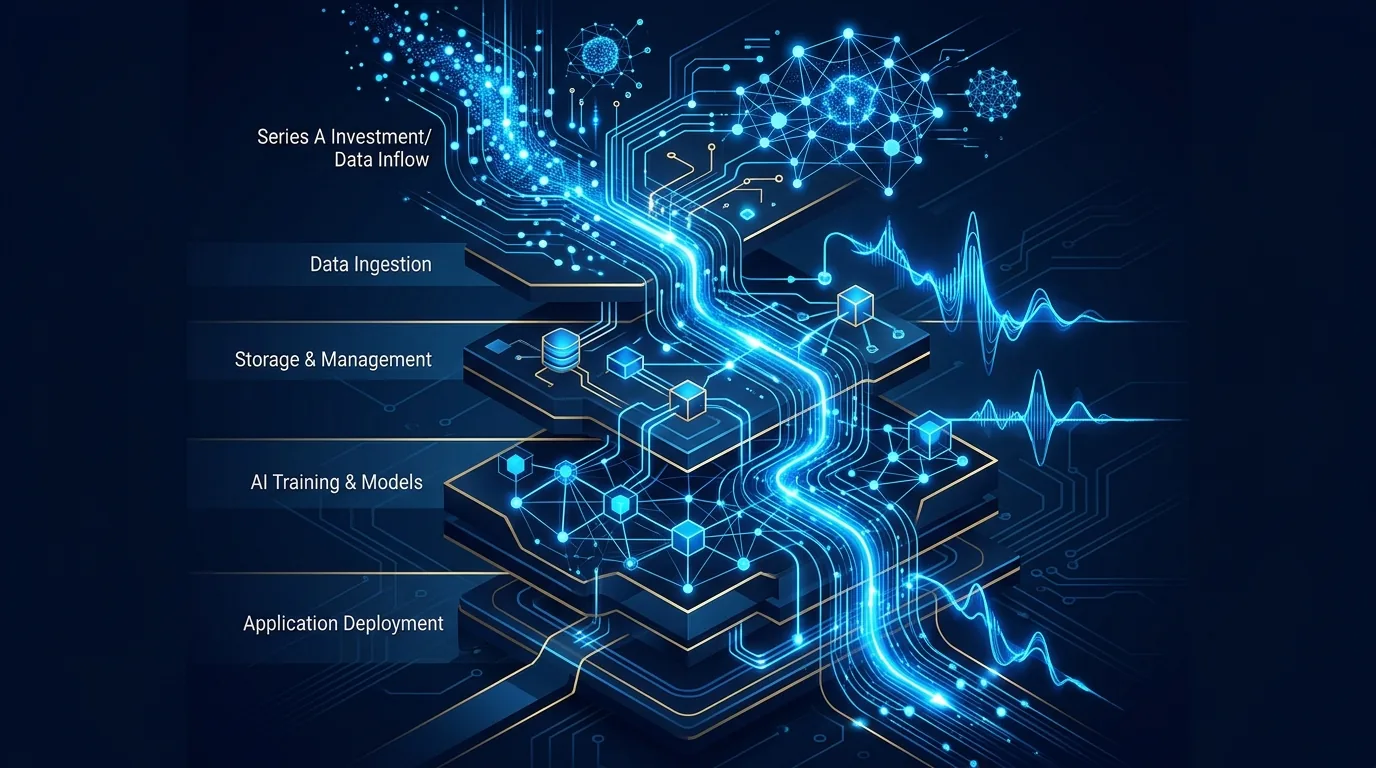
Three signals from this week show investors and enterprise buyers converging on the infrastructure and data connectivity layer of AI, not the model layer. Here is what that means for Series A founders thinking about where their bets should land.
A $1.3 billion VC fund closed Tuesday. A data connectivity product launched Wednesday. A Fortune Global 500 pharmaceutical company went live on agentic AI that same day. Three things in a 48-hour window that, read together, tell a cleaner story about where enterprise AI value is pooling than most quarterly analyst decks.
This week's signals show smart money and enterprise buyers converging on the same layer: infrastructure, data connectivity, and process orchestration. Not models. For Series A founders, the question worth sitting with is whether your product sits at a layer enterprises can connect to, trust, and audit, or whether it assumes someone else has already solved that.
This Week’s Signals
Eclipse bets $1.3B on the layer beneath the models
On April 7, Eclipse Ventures closed a $1.3 billion fund split into $720 million for early-stage bets and $591 million for later-stage deals. The focus is what they’re calling “physical AI”: hardware, robotics, autonomous systems, and compute infrastructure. Their existing portfolio includes Cerebras (AI chips), Wayve (autonomous vehicles), and Redwood Materials (battery supply chain). What the fund is not about is also instructive: no pure-software model plays, no wrapper products, no AI-assisted SaaS features. The conviction being placed here is that durable value accrues to the companies that make intelligence operational in the physical world.
Data connectivity gets priced at $150K per integration
Lucidworks announced April 8 that enterprises using its new MCP server to connect AI agents to internal data can reduce integration timelines by up to 10x. The press release put a number on the problem the product solves:
"Enterprises can reduce AI integration timelines by up to 10x, save more than $150,000 per integration, and accelerate the rollout of AI-powered applications."
The product manager’s framing of why the product exists was equally pointed: “the real challenge is not with the models; it’s with the data feeding into models.” That framing, from someone talking to enterprise buyers every week, is worth noting. They are not struggling to pick a foundation model. They are struggling to make that model useful against the actual systems that run their business.
Agentic AI reaches production inside pharma
Also on April 8, Global AI Inc. announced a fully live production deployment at a Fortune Global 500 pharmaceutical company. The platform handles regulatory reporting, compliance workflows, and payroll, connected across ERP, HR, warehouse management, and financial systems. Pharmaceutical is one of the highest-compliance enterprise environments that exists. When agentic AI clears production in that context, the bar for what “enterprise-ready” means has shifted.
The Thread Connecting Them
The model selection conversation inside most enterprises is largely settled. No one at a Fortune 500 pharmaceutical company is training their own foundation model. The live question for enterprise buyers in 2026 is: how do we connect whatever model we’ve selected to our actual data, at the speed the board expects, in a way we can audit?
Kai Waehner published a vendor landscape analysis on April 6 that captured this shift precisely. The framework maps enterprise AI vendors not by capability, but by two dimensions most founders overlook: enterprise trust (governance, data handling, compliance, geopolitical exposure) and vendor lock-in at the AI layer (API dependency, data gravity, ecosystem capture). His framing: “Agentic AI requires real-time data integration to act on current information, and process orchestration to know what to automate, in what order, and under what conditions. Vendor selection, data architecture, and process intelligence are not sequential decisions.”
Not sequential. That’s the key word. Enterprise buyers are evaluating the entire stack simultaneously: model, data layer, governance, and integration story. The companies getting production contracts this week solved all four. The ones still in pilot cycles are usually stuck on one of them.
Enterprise AI value is accumulating at the data connectivity and process orchestration layer, not the inference layer. This week's investment and deployment signals both point to the same conclusion: the model is increasingly table stakes. What enterprises are buying is the operational layer around it.
What This Means at Series A
The temptation at Series A is to pick a capable model, build a clean product on top of it, and treat data connectivity as a later problem. That approach worked reasonably well in 2023 and 2024. It is getting harder to defend as enterprise buyers become more specific in their due diligence.
The $150,000 per integration number from the Lucidworks announcement is a pricing signal, not just a market observation. It tells us what enterprise customers are currently paying to solve data connectivity without a product like theirs. If what Series A founders are building eliminates that cost for a specific use case, the procurement conversation looks different. If the product assumes clean, accessible data that most enterprises do not actually have, the pilot will stall at exactly that point.
The Eclipse fund structure is also worth filing away. The split between $720 million early-stage and $591 million later-stage tells you where a major institutional backer thinks the remaining risk sits in physical AI. Most of the capital is at the early stage, which means the market structure is still forming. There is room to build. But what Eclipse is funding is not faster demos. It is operational depth.
Enterprise buyers in 2026 are not picking a model. They are picking who owns the layer between the model and the systems they already have.
One Thing to Do
Before the next investor or enterprise conversation, write one sentence that answers: “Our data connectivity story is X, and here is who owns it when something breaks.” Founders who can answer that specifically are the ones converting pilots to production contracts in Q2. The ones who cannot are discovering the question in the middle of a deal.
Sources
- Enterprise Agentic AI Landscape 2026: Trust, Flexibility, and Vendor Lock-in - Kai Waehner, 2026-04-06
- VC Eclipse has a new $1.3B fund to back and build physical AI startups - TechCrunch, 2026-04-07
- Lucidworks Launches Model Context Protocol to Reduce AI Agent Integration Timelines by Up to 10x - GlobeNewsWire, 2026-04-08
- Global AI Secures Enterprise Agentic AI Deployment with Fortune Global 500 Pharmaceutical Leader - GlobeNewsWire, 2026-04-08
Written by Kinan Hamwi, Founder of Cerevisor.