What Experiential Avoidance Looks Like in an AI Workday
Psychologists call the habit of organizing a day around escaping uncomfortable feelings experiential avoidance, and a 2026 study of 1,354 adults found it sits at the crossroads of stress and wellbeing. AI tools now make that escape instant, productive-looking, and hard to spot.
Psychologists call the habit of organizing behavior around escaping an uncomfortable feeling, rather than around what matters, experiential avoidance. A 2026 network study of 1,354 adults found it sits at the busiest crossroads between stress, low mood, and wellbeing, while a workplace diary study found that setting some demands aside can actually protect against exhaustion. The difference is what the move is organized around, and AI tools have made that difference much harder to see from the outside.
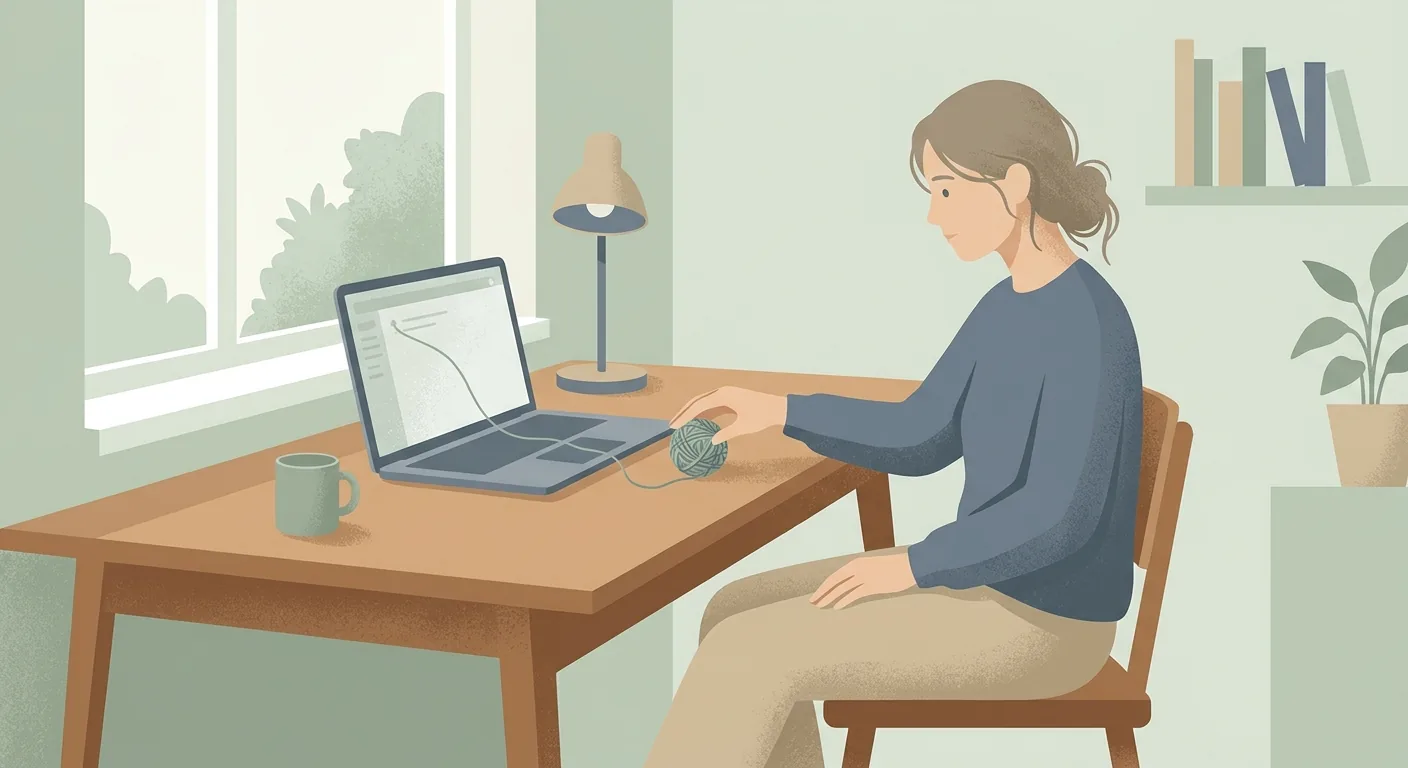
A developer I know described a small moment from her Tuesday. Halfway into writing a hard comment on a colleague’s design doc, the one that risked an argument, she felt the familiar tightening and did something that took four seconds: she opened her AI assistant and asked it to draft the comment instead. Relief arrived immediately. The comment got written. And she noticed, later, that the thing she had handed over was not really the task. It was the feeling that came with it.
Contemplative psychology has a name for that move when it becomes a pattern. It is worth knowing, because the tools many of us work with now make the exit from any uncomfortable moment instant, polished, and indistinguishable from productivity.
What Is Experiential Avoidance, and Why One Habit Touches So Much
Experiential avoidance is a concept from a research tradition that goes back to a 1996 paper by Steven Hayes and colleagues. In plain terms: it is the unwillingness to stay in contact with an uncomfortable inner experience, a thought, a feeling, a bodily tension, plus the things a person does to get away from it, even when getting away costs them something they care about. The escape is the point. The task is just the terrain.
A study published this spring in a peer-reviewed psychology journal gives the clearest recent picture of how central this habit is. Researchers in Chile mapped how stress, mood, and wellbeing hang together in a large group of young adults, using a method that treats each experience as a node in a network and looks for the bridges between neighborhoods.
"In a sample of 1.354 university students from two universities in Chile (Mage=19.28, SDage=2.23; 69.4% females), we performed a psychometric network estimation, identified network communities, and computed traditional bridge centrality indices (strength and expected influence) to identify bridge symptoms."
The finding that matters here: their new indices showed experiential avoidance had the highest bridge connectivity with the stress, low-mood, and wellbeing neighborhoods of the network. Not the loudest node, the most connected one. The habit of fleeing discomfort was the busiest crossing point between feeling pressured, feeling low, and feeling well.
Here is the twist that keeps this honest. Avoidance is not uniformly bad. A diary study published last year in an occupational psychology journal followed 78 employees across 377 working days and found that mentally setting aside taxing demands was linked to lower exhaustion, especially on days with little autonomy and high time pressure. Declining to carry every hard thing is sometimes exactly right. And a study out last month found the calmer route to less avoidance ran through awareness first: people who noticed their inner state more tended to flee it less.
The research distinction is not "avoiding is bad, enduring is good." It is what the move is organized around: the work, or the feeling. Handing a task to an AI tool can be either, and it looks identical from the outside.
The Limits: Student Samples, a Spring Study, and Nothing About AI
The network study is large and careful, but it is a snapshot of university students, not working adults, and a map of connections cannot say what causes what. The diary study used working adults but measured a cousin of experiential avoidance, the deliberate reshaping of one’s job demands, not the inner flinch itself. No fresh study landed this week; the strongest paper here is from this spring. And none of these researchers looked at AI. The bridge from this literature to the four-second handoff is my read of the moment, stated as that, not a finding.
Telling a Handoff From an Escape the Next Time the Tool Opens
The old signs of avoidance were visible: the tidied desk, the suddenly urgent inbox, the coffee run. The new one produces a work product. That is what makes it worth a moment of attention. I have written before about how heavy AI reliance can erode the felt sense of being capable, and about the related question of whether stepping back from a problem is gained clarity or just stepping outside it. This one is smaller and closer to the skin.
One thing to notice today, without fixing anything: the next time the assistant gets opened mid-task, check what was happening one breath earlier. If the answer is a plan, that is delegation. If the answer is a tightening, name it, then decide either way. Handing the work over can still be the right call. The value is in knowing which move it was, and pointing the freed attention at the work where the real returns show up first. The shape of a workday is being renegotiated one small handoff at a time, and noticing is enough for today.
Sources
- Experiential avoidance and mental health in university students: exploring novel indices for bridge communities and node links - Current Psychology, 2026-03-11
- The bright and dark side of avoidance crafting: How work design matters - Journal of Occupational and Organizational Psychology, 2025-09-01
- Physical exercise and depression in college students: the serial mediating roles of mindfulness and experiential avoidance - Frontiers in Psychology, 2026-06-22
- Experiential avoidance and behavioral disorders: A functional dimensional approach to diagnosis and treatment - Journal of Consulting and Clinical Psychology, 1996-12-01
Written by Kinan Hamwi, Founder of Cerevisor.