How to Notice Where Your Attention Goes With AI Tools
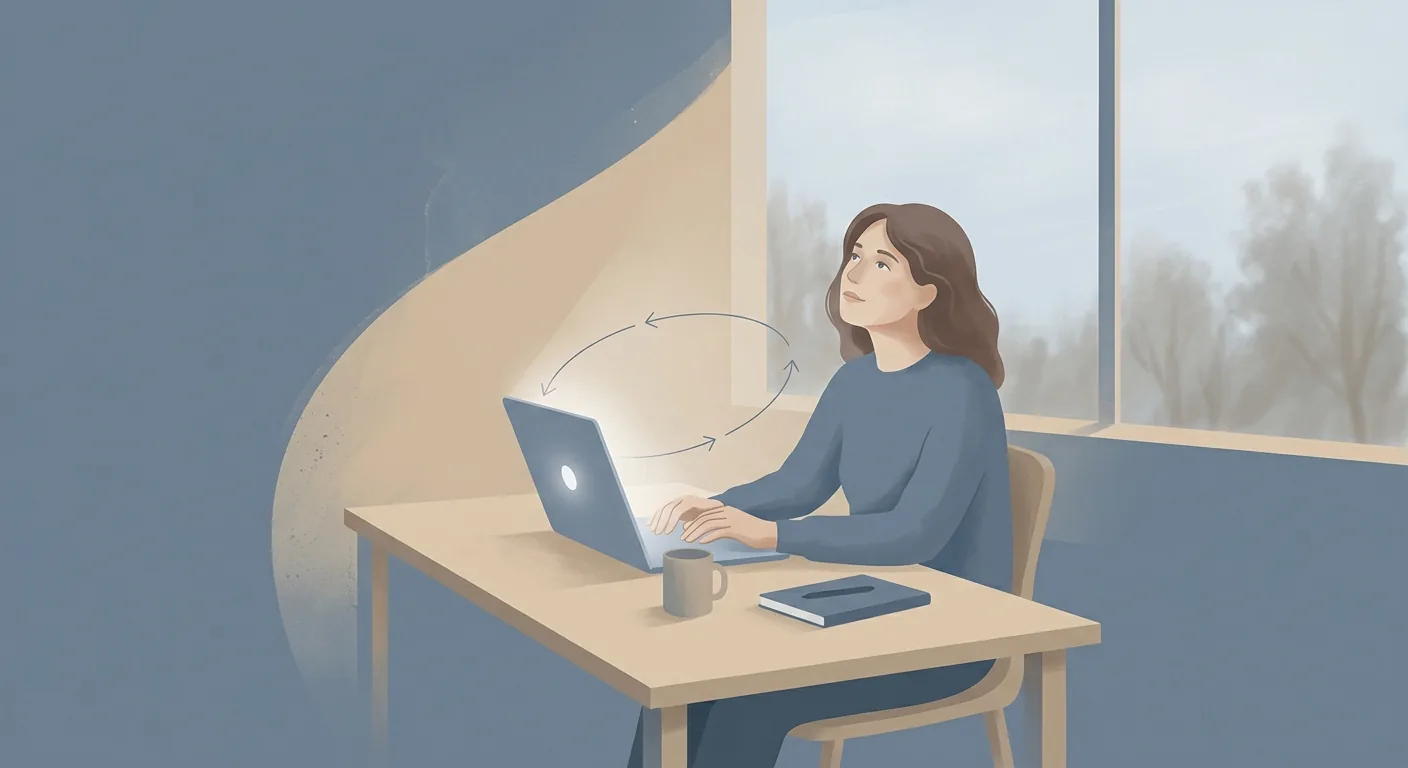
Noticing where your attention sits is a small contemplative skill. Two 2026 studies suggest the noticing itself changes attention, and that checking in carries a quiet cost of its own.
Noticing where attention sits is a small contemplative skill, and two 2026 studies say the noticing itself changes attention. Catching the drift is the lever. But anticipating the check also dipped task performance, so the move is an occasional, light glance at focus, not constant self-surveillance.
What a mid-task focus check is really doing
A developer I know has a small habit. Every so often, mid-task, she stops and asks herself where her attention actually is. Not to fix it. Just to check. She started after a week where she had shipped a lot and remembered almost none of it. What the research says that small check is doing turns out to be anything but neutral.
What two 2026 studies found about catching your attention
There is a plain skill underneath that habit. Researchers call it meta-awareness, which is just noticing, in the moment, where the mind actually is. It is the thing trained in the quieter kinds of meditation, and it is also something some people simply do at their desks.
Two studies from earlier this year looked at it directly. A naturalistic study of people learning from video, published in March in a research journal on how people monitor their own thinking, found that mind-wandering is frequent and mostly slips by unnoticed. The value, the team led by Daniel Ebbert reported, lands in the moments a person catches the drift and adjusts. The catching is the lever, not the absence of wandering. This is close to something I have written about before, the stance a person takes toward an AI output in the half-second before reading it.
A lab experiment from the University of Waterloo, by Adrian Safati and Daniel Smilek, found something sharper. When people knew in advance the exact moments they would be asked to report on their own attention, their mind-wandering dropped as that check approached. So did their performance on the task itself. Bracing to notice pulled resources off the work, not only off the wandering.
"Across two experiments (N = 121, 121) we examined whether the anticipation of metacognitive judgments in the form of experience sampling probes of mind-wandering influenced attentional engagement."
What the research doesn’t settle yet
Worth saying what these do not show. One used a steady tapping task. The other followed people watching lecture videos. Neither involved AI tools at all, so the line from their desks to a working day full of AI is mine to draw, not theirs. The lab study measured attention over seconds, not over an afternoon. And single studies, even careful ones, are a starting point, not a verdict.
Noticing where attention sits is a real lever, and it is not free. The act of checking pulls a little energy off the task too. The skill is in holding the check lightly, not in running it constantly.
One thing to notice in an AI workday
Here is the one thing I would carry into a day spent with these tools. The stream of outputs an assistant returns is easy to stay absorbed in, the way the work itself used to absorb us before the tool did the middle part. A light, occasional check on where attention actually sits can help catch the drift, the same gap I keep coming back to between having a thought and reaching for the tool. The real work still tends to live on the critical path, which is also where the returns from these tools show up first, so a wandering mind there costs more than it looks.
But the studies add a caution worth holding. The check has a cost of its own. This is not a case for monitoring your own mind every minute. It is a case for the occasional glance, held loosely. Try it once this afternoon, somewhere in the middle of a task, and just see where your attention is. The research is still learning what the noticing does. So are the rest of us.
Sources
- The Effects of Anticipating Metacognitive Judgments about Mind-Wandering - Attention, Perception, & Psychophysics, 2026-02-14
- Mind wandering in Video-Based learning: Self-Regulated learning and student responses in a naturalistic setting - Metacognition and Learning, 2026-03-12
Written by Kinan Hamwi, Founder of Cerevisor.