The board asked if AI coding agents shrink your engineering team. PwC just said the opposite.
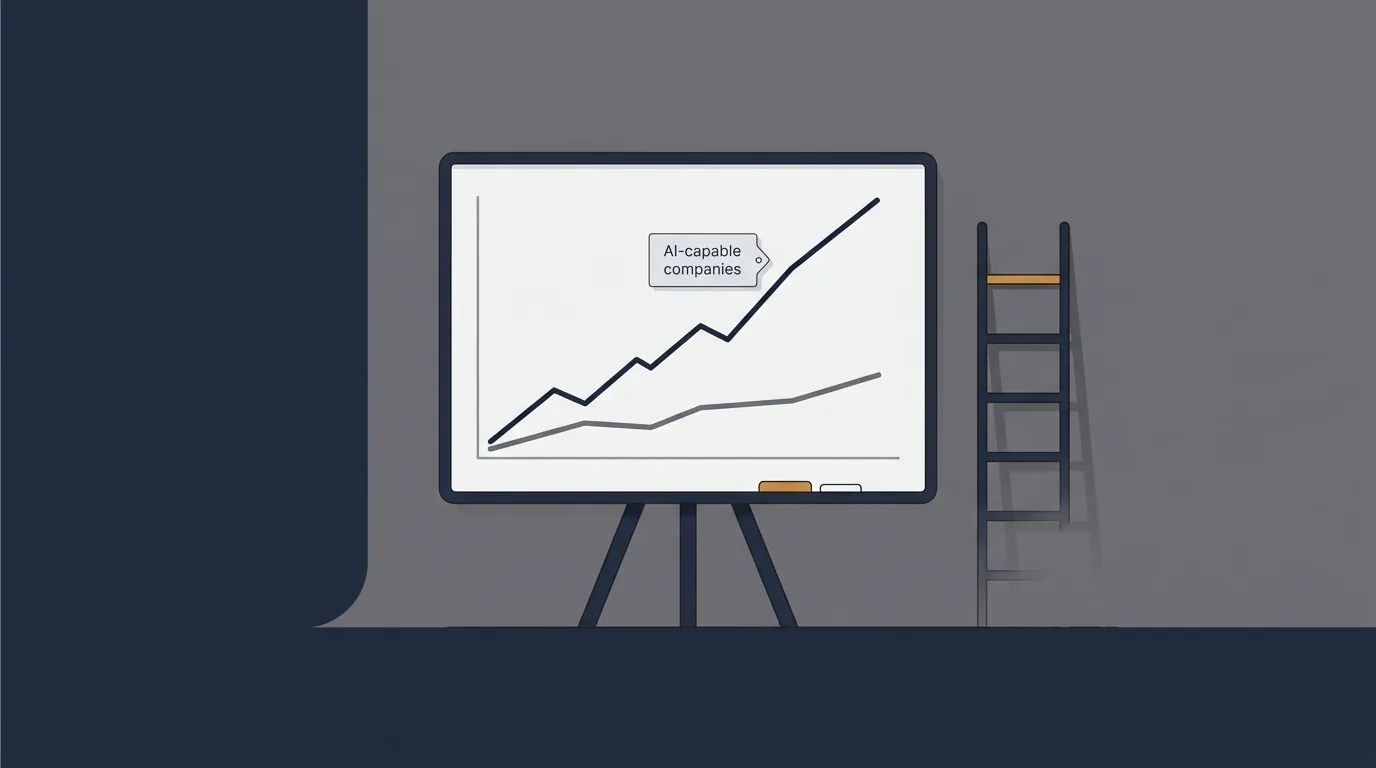
PwC's 2026 Global AI Jobs Barometer found the most AI-exposed companies grew headcount faster than their peers, not slower. Here is how to answer the board question coding agents keep provoking, and the one number that should actually worry you.
PwC's 2026 Global AI Jobs Barometer, out June 15, found the most AI-exposed companies grew headcount 52 percent since 2018 versus 36 percent at the least-exposed. AI coding agents are not, on this data, shrinking the teams that use them well. The number that should actually move the board meeting is the quiet one: entry-level roles are now seven times more likely to demand senior-level skills, and the apprenticeship rung is eroding underneath the org chart.
A board member forwarded me a layoff tracker last week with one line in the email: “Should we be planning for this?” The tracker showed a grim 2026, north of 180,000 tech cuts, half of them tagged to AI. Every CEO I talk to has some version of that email in their inbox right now, usually arriving the same week the CTO asks to expand the Claude Code or Cursor budget. Those two requests feel like they cannot both be right.
Then on June 15, PwC dropped its 2026 Global AI Jobs Barometer, built on more than a billion job ads across 27 countries, and the headline number cut hard against the layoff narrative. So here is the board answer, the honest version, before someone hands a CEO the scary version.
AI is coming for the engineers
The board saw “AI is coming for the engineers.” That story is everywhere, and it is not made up. The cuts are real. The names attached to them are real companies with real R&D org charts.
So before the next planning meeting, it helps to separate the headline from the data underneath it.
But the data underneath the headline points the other direction for the companies actually good at this. PwC’s read is that the labour market is splitting into two paths, and the AI-capable side is the one hiring faster.
AI-capable firms grew engineering headcount faster
Here is the part that took me a second read to absorb. The companies most exposed to AI did not just hold headcount. They grew it 52 percent against a 2018 baseline, while the least-exposed firms grew 36 percent. Wage growth ran stronger too, 24 percent against 17 percent. And the top slice of AI-capable firms posted average labour productivity growth of 163 percent.
So the engineers using coding agents most aggressively work at the companies adding the most people. That is a composition effect, not a contradiction. The layoffs and the hiring are happening in different buildings. The cuts cluster where AI adoption is shallow or where the work was already commoditised. The growth clusters where teams turned coding agents into more shipped product, and more shipped product turned into more roles to design, review, and own it.
As PwC put it in the report: “The top 20% of most AI-exposed companies achieved … headcount growth of 52% compared with 36% among the least AI-exposed firms.”
"Across the global economy, we're beginning to see a new divide emerge between different models for talent and value creation."
One honest caveat, because I would want my own CTO to flag it. PwC sells AI services. A report from PwC finding that AI-forward companies thrive is not a neutral lab result, and the Barometer measures job ads, which signal intent more than filled seats. I would not stake the board narrative on the 52 percent alone. I would stake it on the direction, which independent coverage from Euronews and the wire copy carrying the same figures both corroborate, and on the fact that it matches what most of us see inside AI-capable teams: agents made the work cheaper, so these companies bought more of it.
The teams that use coding agents best are not shrinking. They are buying more software, because software got cheaper to make, and more software needs more humans to own it.
Whether to keep hiring engineers, answered
“So we should keep hiring engineers?” Yes for the genuinely AI-capable company, and carefully for the one that is not. The defensible move is not a freeze and not a spree. It is to tie any headcount change to a measured productivity delta on the team’s own merge data, then adjust the plan a quarter or two out, not in the same board meeting where someone showed a layoff tracker. Freezing hiring to look disciplined while competitors compound output is the expensive mistake hiding inside the cautious one.
“Then why is everyone laying off engineers?” Because the cuts and the growth live on different sides of PwC’s divide, and because a layoff makes a cleaner headline than “we restructured around AI-capable teams.” Some of those cuts are real AI leverage. Some are macro belt-tightening wearing an AI costume because AI is the more flattering reason to give the market. The work is knowing which one applies here.
“What is the real risk, then?” Not the size of the team. The shape of its bottom rung. That is the number I would put on the slide.
The headcount question is mostly settled by the data. The unsettled question is who replaces today's senior engineers in seven years if AI quietly eats the work that used to train them.
Entry-level roles now demand senior skills
Buried in the same PwC release is the stat I cannot stop thinking about. Entry-level positions most exposed to AI are now seven times more likely to require skills traditionally associated with senior staff. Demand for those seniorised entry-level roles rose 35 percent since 2019, while ordinary entry-level vacancies fell 10 percent.
Read that as an engineering leader and it is obvious what happened. AI coding agents ate the junior work. The tickets a team used to hand a new grad, the small bug fixes, the boilerplate, the “go figure out how this module works and patch it,” that was never just throwaway work. That was the apprenticeship. PwC named it directly.
"The traditional relationship between experience and expertise is changing. AI is removing some of the routine work that once acted as an apprenticeship."
Hire only people who already think like seniors and the quiet assumption is that someone else will train the next generation of seniors for free. That math does not close. Microsoft’s own Azure CTO Mark Russinovich and Scott Hanselman made a similar argument back in April, that agents boost seniors while putting a drag on early-career developers, and the fix they landed on is the one that holds up: keep hiring juniors, but pair them with both a senior human and the agent, and treat the apprenticeship as a thing to design on purpose rather than something that happens by accident in the ticket queue.
AI-capable firms are hiring engineers, not freezing
One minute with the board sounds like this. The best data we have, out this week from PwC, says AI-capable companies are growing engineering headcount faster than their peers, not slower, so we are not going to freeze hiring out of fear of a headline. We will tie any change to our own productivity numbers. The real risk these coding agents create is not team size, it is that they eat the junior work that used to grow our future senior engineers, so we are going to keep an entry-level pipeline and build the apprenticeship deliberately. That is a plan a board can hold without flinching, and without bravado.
Watch entry-level reqs drifting senior
Watch whether your entry-level reqs are quietly drifting senior in their requirements, because that drift is how a hiring freeze sneaks in without anyone deciding on one. And watch the next survey that splits AI-capable firms from the rest rather than averaging them, because the average is where this story goes to die. The companies winning here are not the ones with the most agents or the fewest people. They are the ones who kept building the bench while everyone else was reading the tracker.
Sources
- AI reshapes global labour market into two distinct paths, rewarding human skills: PwC 2026 Global AI Jobs Barometer - PwC, 2026-06-15
- AI reshapes global labour market into two distinct paths, rewarding human skills: PwC 2026 Global AI Jobs Barometer - PR Newswire, 2026-06-15
- Human skills increasingly in demand as AI reshapes labour market, PwC finds - Euronews, 2026-06-16
Written by Kinan Hamwi, Founder of Cerevisor.