A free AI coding assistant just exposed the gap in your evaluation checklist
A Beijing lab shipped ZCode this week, a free, open-weight, genuinely agentic coding environment that scores near the frontier. The zero price strips away the usual filter and exposes the two questions most AI coding assistant evaluations skip: are you buying an assistant or an autonomous agent, and where does your code go when it runs?
A Beijing lab shipped ZCode this week, a free, open-weight, genuinely agentic coding environment that scores near the frontier and costs nothing to download. The story is not the price. It is that a free tool forced the question most buy checklists skip: are you standardizing on an assistant or an autonomous agent, and do you know where the code travels when it runs?
On July 2, a company most executives have never heard of made the free AI coding assistant conversation more honest. Z.ai, the Beijing lab formerly called Zhipu AI, released ZCode: a free desktop app it describes as an “Agentic Development Environment,” built around its open-weight GLM-5.2 model. It runs on macOS, Windows, and Linux. It wraps a terminal, a Git panel, a file manager, and a live browser preview around a single agent conversation. And it costs zero dollars to download.
I spent an evening reading the coverage, and the interesting part was not the tool. It was watching every write-up reach for a different word to name what ZCode actually is. Assistant. Agent. Harness. IDE. Environment. Five words for five different purchases, all pointed at one download link.
That confusion is the thing worth attention this week.
Why a free download broke the best AI coding assistant shortlist
Here is the pattern I keep seeing. A team asks “which AI coding assistant should we standardize on,” gathers a few names, lines up monthly prices next to a benchmark chart, and picks the winner. The whole exercise treats these tools as one category wearing different logos.
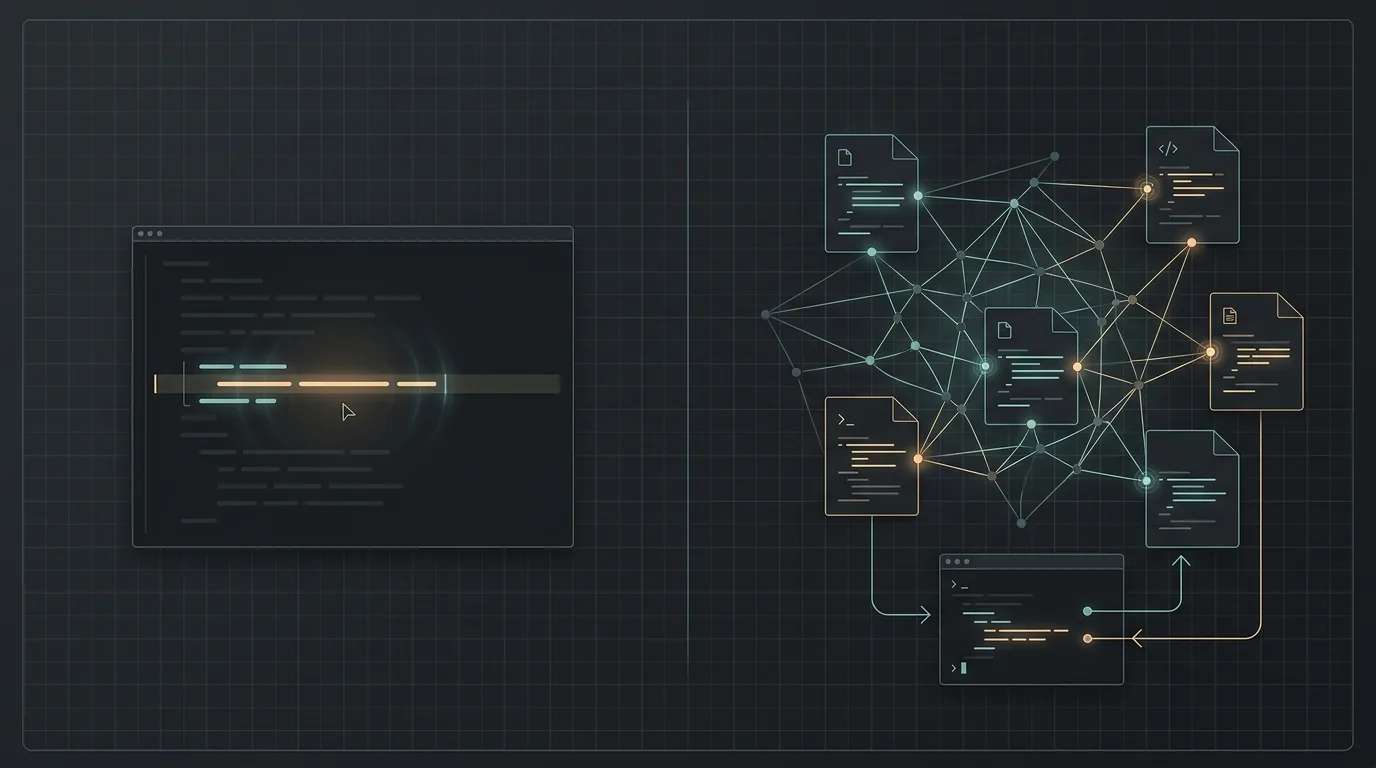
They are not one category. Some of them suggest the next line inside the editor. Some of them take a goal, edit a dozen files, run the test suite, read the failures, and try again without asking permission. Those are different machines doing different jobs at different levels of risk. ZCode made that obvious, because it is aggressively the second kind, and it is free, so the usual sorting filter does nothing.
When the cheapest tool on the table is also the most autonomous, price stops sorting the options. The decision quietly shifts from "how much does it cost" to "what is this thing allowed to do to our codebase."
An AI coding assistant and an agentic coding agent are two different buys
Let me draw the line cleanly, because it changes the whole evaluation.
An assistant works inside the editor. It completes a line, answers a question about a function, drafts a block a developer reviews as it appears. The in-editor coding assistant tools live here: Copilot’s autocomplete, and standalone assistants like Tabnine, Codeium, or Qodo. The blast radius of a bad suggestion is one keystroke from a human eye. The right things to score are suggestion quality, latency, and how well it reads the surrounding code.
An agentic AI coding assistant works on a task instead of a line. You describe an outcome and it plans, edits across files, runs commands, and iterates until it decides the job is done. As Flowtivity described ZCode’s Goals feature, the agent “plans the work, edits files, runs tests, reviews results, and iterates until the goal is done.” That is a very different thing to hand a repository. The blast radius is however many files and shell commands it touched before a person looked.
| Question | Assistant (in-editor) | Agent (autonomous) |
|---|---|---|
| What you score | Suggestion quality, latency, editor fit | Action surface, verification, rollback, data path |
| Blast radius of a mistake | One line, human-visible | Many files and commands, found later |
| The question that matters | Is it a good pair? | Can we contain it when it is wrong? |
Most “ai coding assistant” evaluations use the left column to judge a tool that lives in the right column. That is the first half of the gap.
The evaluation grid scores the model and skips where the code goes
Here is the second half, and ZCode makes it vivid.
The benchmark chart everyone screenshots measures the model. GLM-5.2 is a 753-billion-parameter open-weight model with a million-token context window, and on several long-horizon coding benchmarks it trades blows with frontier Western models at a fraction of the token cost. An evaluation that stops at that chart makes ZCode look like an easy yes.
But the model is the layer that changes monthly. What actually sets the risk is the harness around it and the path the code takes when the agent runs. On the free hosted tier, every prompt and every file the agent reads travels to Z.ai’s infrastructure. As Let’s Data Science put it, “adopting a coding agent built by a Chinese lab means routing source code and prompts through infrastructure subject to different data-governance and export-control assumptions than US-based tools.” TechTimes ran it more bluntly on July 4: China’s data law applies to every GLM-5.2 API call.
Now, before this turns into a geopolitics lecture, here is the honest part. Source code goes somewhere with every hosted assistant. Copilot sends it to Microsoft and OpenAI. Claude Code sends it to Anthropic. Cursor sends it to whichever model got picked. ZCode did not invent the data path.
ZCode did not invent the data path. It just made the path impossible to ignore, because the jurisdiction is unfamiliar and the weights are open.
Because the license is MIT and the weights are downloadable, a regulated buyer who cannot route code offshore has an option most hosted assistants never offer: run the same model on owned hardware and cut the path entirely. So the lesson is not “avoid the foreign tool.” The lesson is that “where does our code go” belongs on the same page as the benchmark score, for every tool on the shortlist, and almost no evaluation grid has that row.
What a free, open-weight AI coding assistant actually costs to run
Free download, real economics underneath. ZCode’s metered usage runs through Z.ai’s GLM Coding Plan.
"Lite tier at $16.20/month and a Max tier at $144/month, versus roughly $20-$200 for comparable competitor tiers."
A few numbers worth holding. The free trial hands over 3 million GLM-5.2 tokens plus 2 million turbo tokens a day for five days, no setup. Pay-as-you-go runs about $1.40 per million input tokens and $4.40 per million output. And the whole category, per the Gartner figure cited across the launch coverage, is now roughly a $10 billion market.
Put together, the “free ai coding assistant” headline hides three separate cost questions. There is the metered token bill once the trial ends. There is the near-monthly churn in AI coding assistant pricing changes across this whole category, where a plan that looked cheap in June is a different plan by August. And there is the cost of the governance work if production code routes through any hosted tier. Free answers none of those three. It just removes the one number that used to let a team feel like it had done the analysis.
Five checks before standardizing on an AI assistant for coding
This is the part to actually run. It works for a free open-source AI coding assistant like ZCode and for the paid incumbents equally.
-
Name the category before comparing tools
Decide whether the purchase is an assistant (in-editor autocomplete) or an agent (autonomous task execution). Write it down. The two need different checklists, and a single shortlist that mixes them will compare the wrong things.
-
Score the harness, not just the model
The model changes monthly and the benchmark crown moves with it. Evaluate the durable layer: what the tool can edit, what it can run, what it is allowed to do unattended, and exactly how a human stops it mid-task.
-
Add the data-path row to every tool
For each candidate, write one line: where does our code go when this runs, and can we cut that path if we have to (self-host, on-prem, zero-retention). ZCode's open weights make that row answerable. Some tools cannot answer it at all, and that is itself the answer.
-
Test the free tier as if it were paid
A free, capable agent gets adopted bottom-up whether it was evaluated or not. Run it against one real task, watch every file and command it touches, and price the metered bill for the month after the trial ends.
-
Name one owner and a re-check date
Assign a person to own the choice and put a 30-day re-evaluation on the calendar. The tool picked today will not be the same tool in a month, and an unowned decision quietly becomes whatever an engineer installed on a Friday.
Here is why ZCode is useful even for a team that never installs it. It stripped the price signal out of the decision and left the thing that was always the real question sitting in plain view. Not which coding assistant is best. What is actually being handed the codebase, and does anyone know where it goes when no one is watching. A free tool that forces a clear answer to that is worth more than a paid one that lets the question stay comfortably unasked.
Sources
- Z.ai launches ZCode AI coding environment - Let's Data Science, 2026-07-02
- Z.ai Unveils ZCode, an 'Agentic' AI Coding Environment Built Around GLM-5.2 - TechBooky, 2026-07-02
- ZCode Explained: Z.ai's Agentic Dev Environment for GLM-5.2 - Digital Applied, 2026-07-03
- ZCode: The Open-Source Coding Agent Harness Chasing Cursor and Claude Code - Flowtivity, 2026-07-03
- AI Coding Assistant ZCode Launches Free: China Data Law Applies to Every GLM-5.2 API Call - TechTimes, 2026-07-04
Written by Kinan Hamwi, Founder of Cerevisor.