How much of your harness setup moves when switching vendors?
Cursor's v3.3 release names the four portable primitives in its own UI: rules, skills, MCPs, and subagents. Engineering leaders signing the June renewal should audit each layer separately, because the lock-in has migrated up to the orchestration glue and the governance plane.
The June renewal is on the calendar. Cursor’s admin-system migration deadline lands June 1. IBM Bob hit general availability at Think 2026 last week. Microsoft Agent 365 went GA on May 1 at $15 per user per month. Anthropic launched the Claude Agent SDK on May 6 and put Claude Managed Agents into public beta the same day. GitHub Copilot CLI shipped a Claude-powered subagent inside its own session on May 7.
Every one of these is being framed by someone, somewhere, as a reason to pick a winner.
I think that is the wrong question. The actual question is sharper: when an engineering leader signs a 12-month renewal in June, how much of the team’s current harness setup moves with them if they switch in nine months?
Four primitives in your harness setup are now openly portable: rules, skills, MCPs, and subagents. The orchestration glue and the governance plane are not. Audit each layer separately before signing the June renewal, because the lock-in has migrated up a tier and the seat-line negotiation is no longer where the cost actually lives.
The four layers, scored by switching cost
I keep doing this audit with engineering leaders, and the same four-layer breakdown comes out every time. The reason it works is that the harness vendors have stopped hiding it. They put it in their own product UI this week.
Cursor’s v3.3 release on May 6 added a Context Usage Breakdown view. The exact wording from the changelog:
"You can now see a breakdown of your agent's context usage. Use these stats to diagnose context issues and improve your setup across rules, skills, MCPs, and subagents."
Read that quote slowly. Cursor, in its own product, is naming four things: rules, skills, MCPs, subagents. Three of those four are open standards. The agentskills.io site now lists more than thirty named clients including Cursor, Claude Code, GitHub Copilot, OpenAI Codex, Junie, Gemini CLI, Goose, Roo Code, Amp, OpenCode, OpenHands, Snowflake Cortex Code, Databricks Genie Code, ByteDance TRAE, plus another twenty besides. MCP works the same way. The Anthropic Agent SDK that launched May 6 is callable from external developers.
So layer one, rules and skills, is portable. Layer two, MCPs, is portable. Layer three, subagents, is mostly portable through the same Skills standard plus the SDK contract. The exception is when a subagent is wired to vendor-specific orchestration features, which is layer three-and-a-half and bleeds into layer four.
Layer four is where the lock-in actually sits in May 2026. It has two halves. The orchestration glue, which is the vendor-specific scaffolding that holds the agents together: Claude Managed Agents Routines, Anthropic Outcomes rubrics, Cursor’s parallel Build Plan flow, GitHub Copilot CLI’s Rubber Duck wiring inside its experimental flag system. And the governance plane, which is the policy enforcement and audit surface that sits above all of it. The Microsoft 365 blog published a pretty clean framing of this on May 5: “Microsoft Agent 365 is a unified control plane that keeps agents governed, observable, and secure,” explicitly governing local agents “like OpenClaw and Claude Code.”
The harness moves. The plane that governs the harness does not.
Why most teams get this wrong
The first mistake is treating the harness as a single unit. People say “we use Claude Code” or “we use Cursor” the way they used to say “we use Postgres.” But a harness in 2026 is five things stacked, and only the top three move freely.
A harness in mid-2026 is not one product. It is layers. Three are portable open standards. Two are vendor-specific lock-in. Renewal-cycle thinking that treats the whole stack as a single line item gets the math wrong on both the cost of staying and the cost of switching.
The second mistake is forgetting that the governance plane has its own contract, its own seat price, and its own switching cost. Once an org runs Microsoft Agent 365 as the policy layer over Claude Code and Copilot CLI and Cursor at the same time, the harness becomes the cheap commodity in the stack and the governance layer becomes the renewal that actually matters. Anthropic launched Claude Managed Agents into public beta May 6 partly because that is the same play from the other direction.
There is a third mistake worth flagging. Some teams have spent the last six months building elaborate orchestration patterns inside one specific harness, things like Claude Managed Agents Routines or Cursor’s parallel Build Plan flow. Those patterns are real productivity. They are also deeply non-portable. Per 9to5Mac’s May 7 reporting on Anthropic’s update, “Netflix has already deployed multiagent orchestration for its platform team.” That is impressive engineering and it absolutely will not survive a switch to a different harness without a rewrite.
The fourth mistake is the quiet one. Engineering leaders sometimes treat the orchestration glue as if it were free, because the vendor shipped it. It is not free. It is the most expensive thing in the stack to recreate, because it encodes how the team actually works, and that knowledge does not live in a SKILL.md file.
The numbers worth pulling
A few in-window data points worth bringing to the renewal conversation.
"API volume is up 17x year-on-year on the Anthropic platform."
That is the harness-volume context. Anthropic from stage said the same growth metric Q1-annualized lands closer to 80x. Whatever number lands in the next earnings cycle, the trend is one direction, and it is the reason every harness vendor is racing to lock the orchestration tier above the harness this quarter.
The Skills layer is genuinely portable across that breadth. Cursor, Claude Code, GitHub Copilot, OpenAI Codex, Gemini CLI, Goose, Amp, Junie and the rest are all on it. If a team has a directory full of SKILL.md files, those files survive a harness change with effectively zero rewrite cost.
GitHub Copilot CLI’s Rubber Duck went generally cross-vendor on May 7. The exact wording:
"Rubber Duck...is now available using a Claude-powered critic agent when your session is using a GPT model."
Read that as a public concession from one of the largest harness vendors that the orchestration session must now call competing models inside itself to be competitive. Cross-vendor model dispatch is no longer a hack. It is a documented harness primitive, shipped by the vendor.
Ship it
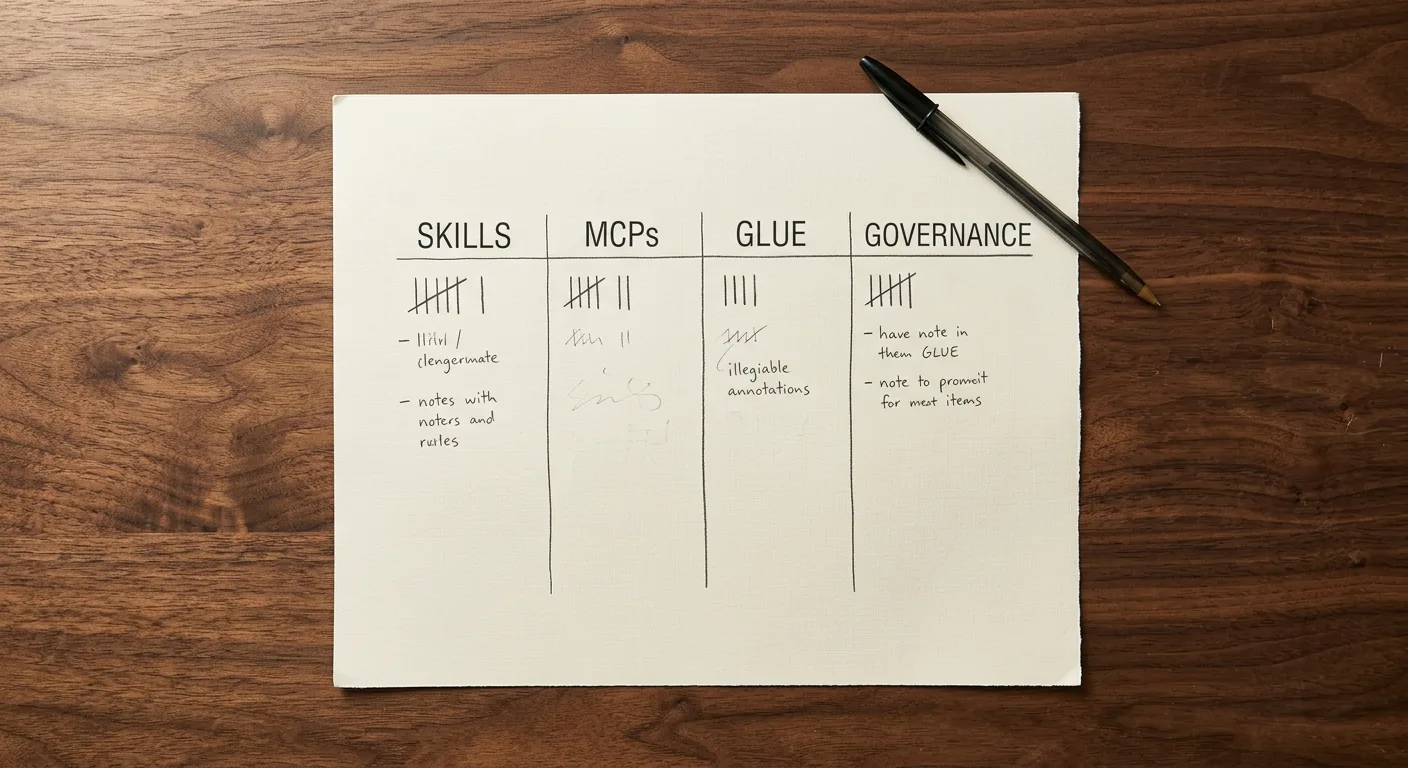
Here is what I would do this week, before the June renewal hits the docket. Open a single page. Four columns: skills and rules, MCPs, orchestration glue, governance plane. List every existing artifact under the right column. Score each row by what it costs to recreate on a different harness.
The skills and rules column should mostly read “zero, the file moves.” The MCPs column should mostly read “zero, the server moves.” The orchestration glue column will hurt the most, and that pain is the actual cost of vendor lock-in for the team in 2026. The governance plane column is the one to walk into the FinOps conversation with first, because that is where the renewal math is being decided whether or not anyone has named it yet.
The harness is no longer the single question. The four layers are. Run the audit before signing.
Sources
- Rubber Duck in GitHub Copilot CLI now supports more models - GitHub Changelog, 2026-05-07
- Cursor Changelog: Context Usage Breakdown (v3.3) - Cursor, 2026-05-06
- Microsoft 365 Copilot, human agency, and the opportunity for every organization - Microsoft 365 Blog, 2026-05-05
- Live blog: Code w/ Claude 2026 - Simon Willison's Weblog, 2026-05-06
- Anthropic updates Claude Managed Agents with three new features - 9to5Mac, 2026-05-07