How to read the new execution-quality report your broker files in September
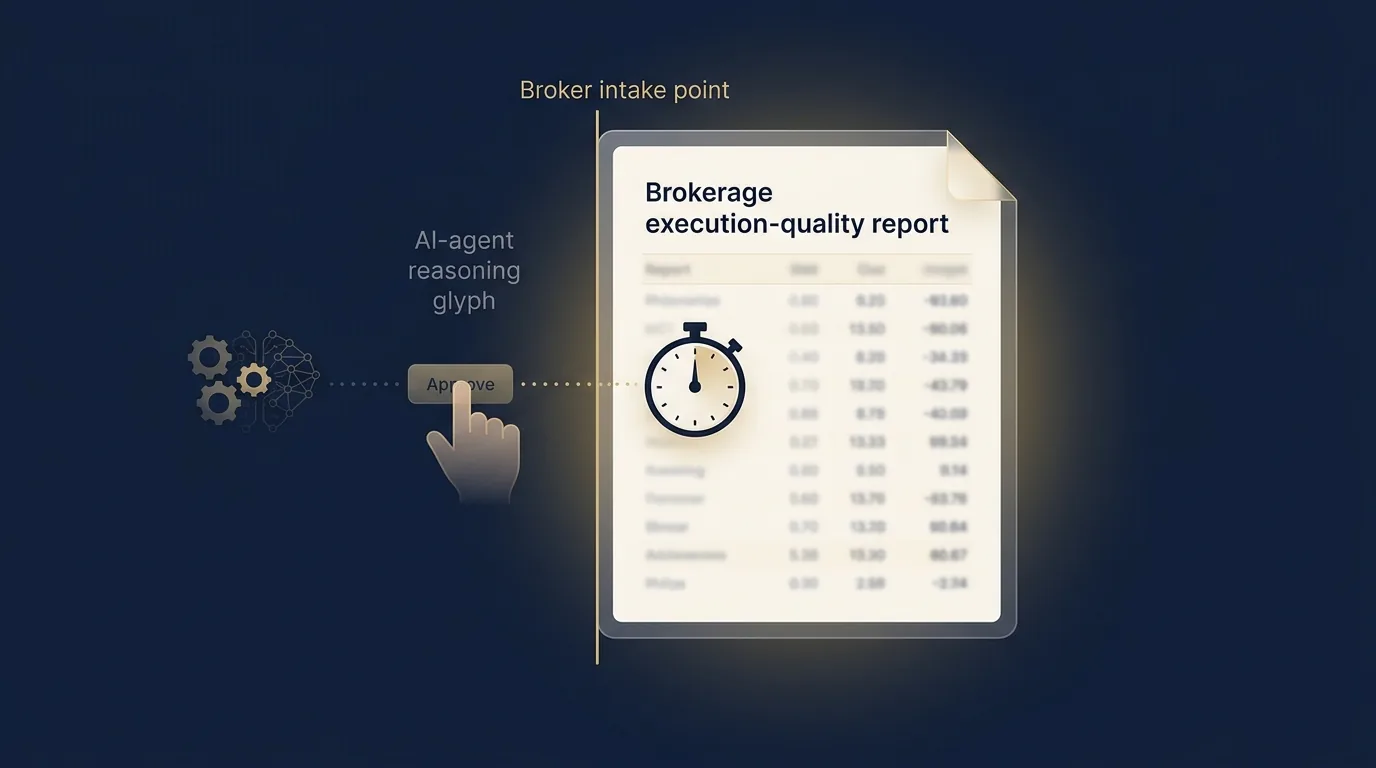
The amended Rule 605 brings Fidelity, Schwab, Robinhood and Interactive Brokers into mandatory execution-quality reporting from August, with millisecond timing and realized-spread statistics. The mechanism worth knowing before the first reports land is that the clock starts when the broker receives the order, so an AI agent's reasoning and your approval tap happen off the record.
From August 1 the amended Rule 605 forces Fidelity, Schwab, Robinhood and Interactive Brokers to publish monthly execution-quality reports for the first time, with timing measured to a millisecond or finer. The number worth understanding before the first reports land in September is where the clock starts: at the moment the broker receives the order. For an AI agent that reasons for several seconds and then waits at the approval tap, that whole pre-receipt delay sits off the record, so a clean report and a slow fill can both be true at once.
There is a disclosure most of us have never read because, until now, our own broker was not required to produce it. That changes in five weeks. The Financial Industry Regulatory Authority confirmed on June 17 that the amended version of the Securities and Exchange Commission’s order-execution rule, Rule 605, takes effect on August 1, and that the first monthly report covering August data must be public before the end of September. For the first time, any broker that carries 100,000 or more customer accounts has to publish how well it executed our orders, which sweeps in the four platforms most of us actually use.
The timing is almost too neat. The week these reports were being wired up, Interactive Brokers extended its conversational agents (ChatGPT, Grok and Claude) to options and futures, and the same retail accounts are now placing orders through a language model that pauses for us to tap approve. So the question is narrow and practical: when these reports arrive, what will they actually tell us about how our agent-placed orders are filling, and what will they quietly leave out?
What the September reports will and will not contain
The old Rule 605 only covered formal market centers, so most retail brokers never filed one. The amended rule covers the brokers themselves, and it is genuinely richer than its predecessor. Order-size categories are no longer just share counts; they now key off notional dollar value and whether an order is a fractional share, an odd lot, or a round lot or larger. That matters because a single share of a $200-plus stock is an odd lot, so most of our orders now fall into buckets the old report ignored entirely.
The headline upgrade is timing. The report measures average time to execution in increments of a millisecond or finer, and it adds realized-spread statistics struck at several fixed points after the trade.
"average realized spread statistics calculated at 50 milliseconds, 1 second, 15 seconds, 1 minute, and 5 minutes after the time of execution"
Realized spread is the part of the cost that the market maker actually keeps after the price drifts in the seconds following the fill, so seeing it at 50 milliseconds versus 5 minutes tells us how much of the apparent price improvement survived contact with the next few ticks. This is real information, and the brokers we use have never had to show it before. There is no central library for these reports either; each firm self-publishes and posts a link, so finding ours will take a deliberate click rather than a single government page.
Why the report starts its clock after the agent already decided
Here is the mechanism worth carrying into the autumn. Every statistic in a Rule 605 report is computed from one anchor point: the moment the order is received and becomes executable inside the broker’s systems. The amended rule is strict about pinning that instant. As the consultant Mark Davies put it when the final rule landed, firms now have to do a market replay to identify when an order became executable rather than when it was received, then measure everything forward from there.
Read that twice, because it defines the edge of what the report can see. The millisecond timing, the realized spread, the price improvement: all of it is measured from receipt onward, and none of it can see anything that happened before the order arrived at the broker.
Now place an AI agent in front of that line. A conversational trading agent reads a price snapshot, reasons over it for a stretch of seconds, drafts an order, then waits for us to review and tap approve. Interactive Brokers and Robinhood both build that human checkpoint in on purpose, and it is a genuinely good safety feature. But every one of those seconds, the agent’s thinking plus our approval pause, happens before the broker receives the order, so the entire decision-to-receipt gap falls outside the measurement window. The report can show a flawless millisecond fill on a price that already moved while the agent was reasoning and we were reading. A clean execution-quality number and a stale decision price are not contradictions. They are two different clocks, and the report only owns the second one.
Rule 605 grades the broker from order receipt forward. An AI agent's reasoning time and your approval tap happen before receipt, so the slowest, most decision-sensitive part of an agent-placed trade is structurally absent from the report meant to grade how well it traded.
This is not a loophole anyone inserted. It is the natural seam between a disclosure rule written for orders and a workflow where something now thinks before the order exists. The rule does its job well inside its window. The window just starts after the part of the process the agent introduced.
Steps to take when your broker posts its first report
-
Find the link before October
There is no central repository. Each broker self-publishes and registers a hyperlink through the Financial Industry Regulatory Authority gateway, so locate your broker's execution-quality page now and bookmark it for the late-September drop.
-
Read the realized-spread columns, not just price improvement
Compare the 50-millisecond figure with the 1-minute and 5-minute figures. A wide gap shows how much of the headline price improvement faded in the seconds after the fill.
-
Check which size bucket your trades land in
Single shares of expensive names and fractional orders sit in the new odd-lot and fractional categories. Read those rows, since that is where most agent-driven and dollar-based orders now fall.
-
Add your own pre-receipt clock
For agent-placed trades, note the price the moment the agent proposed the order and the price when you approved it. That difference is the part Rule 605 cannot show, and only you can measure it.
-
Treat a good report as necessary, not sufficient
A strong Rule 605 page means the broker handled the order well once it arrived. It says nothing about whether the agent's decision price was still live. Keep both judgments separate.
None of this argues against the new report, which is a real gain in transparency, nor against agents, which save us genuine time. It argues for reading the report for exactly what it is. We are stepping into the most data-heavy stretch of the calendar (the May inflation reading printed June 25 and the jobs report lands July 2), into a market already rotating out of mega-cap tech on the session TheStreet covered June 26. In a tape moving like that, the seconds between an agent’s decision and our approval are not free, and the cleanest execution report in the world will not bill us for them. The question worth sitting with is whether the next version of this rule ever tries to put a clock on the part of the trade that now happens before the order is born.
This is editorial analysis, not investment advice. Cerevisor does not hold or recommend the named positions, and information here can become stale within hours of publication.
Sources
- Information Notice: New Rule 605 Designated Participant Authorization Form - FINRA, 2026-06-17
- SEC Adopts Amendments to Modernize Disclosure of Order Execution Information - Sidley Austin LLP, 2024-04-01
- SEC Rule 605 is Final, But More is Pending with Market Structure - FlexTrade, 2024-05-01
- Economic Brief: PCE data and June jobs report headline a data-heavy two weeks - Kraken Blog, 2026-06-24
- Stock Market Today (June 26, 2026): Nasdaq and S&P 500 tread water amid tech sell-off - TheStreet, 2026-06-26
- IBKR Broadens AI Trading Reach With ChatGPT, Grok Integration - Yahoo Finance / Zacks, 2026-06-22
Written by Kinan Hamwi, Founder of Cerevisor.