Why a stop-limit order can protect your price and lose your position
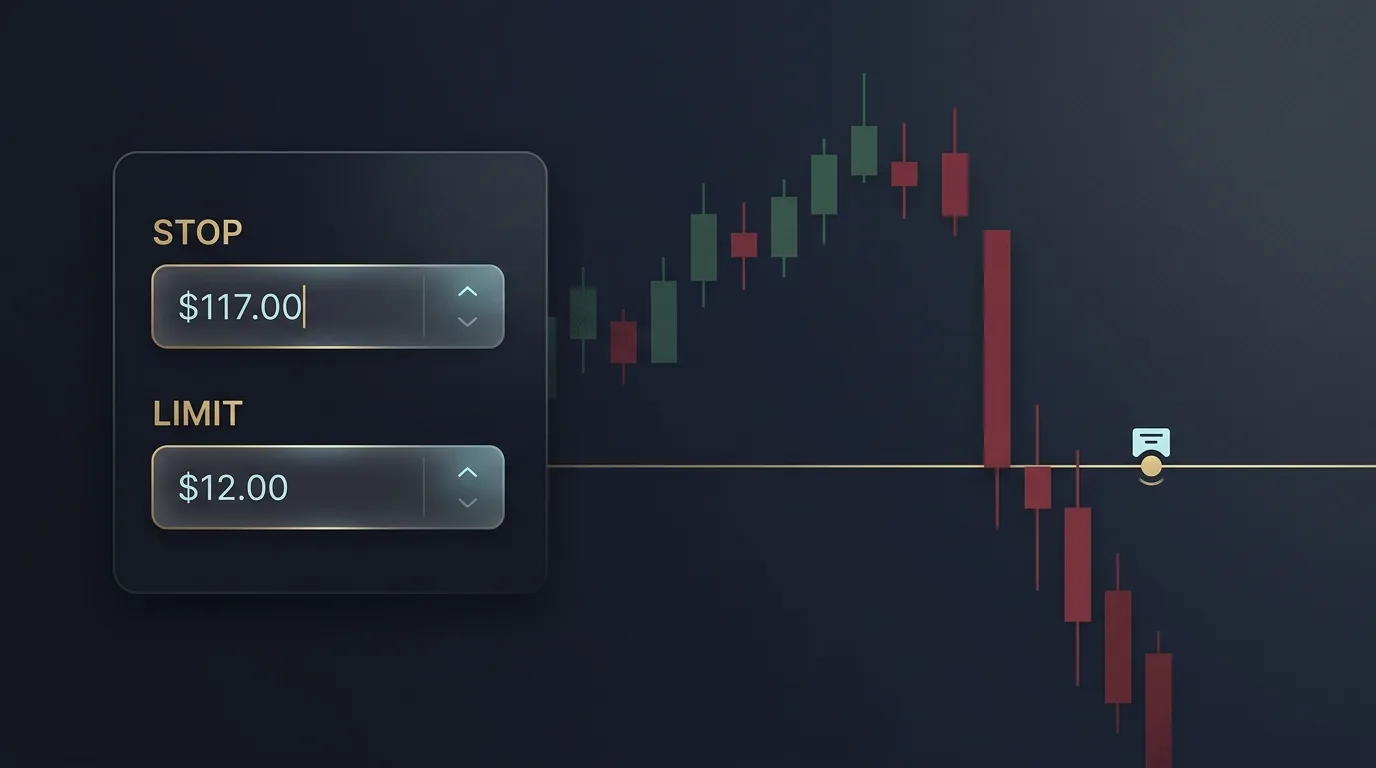
A stop-limit order does not become a market order when it triggers, it becomes a limit order, so a fast gap-down can trade straight through the limit and leave the position unexited. That failure mode matters more now that an AI copilot can place the order and treat the approval tap as the end of the job.
A stop-limit order does not become a market order when it triggers. It becomes a limit order resting at the limit price, so in a fast gap-down the price can trade straight through that level and leave the order unfilled and the position open. That is the opposite of the protection most of us think we bought, and it matters more now that an AI copilot can place the order for us and treat the approval tap as the end of the job.
On July 2, the Dow closed at a record above 52,900 while the Nasdaq Composite slipped 0.8% as chip names sold off. A green tape at the index level, and underneath it, single stocks gapping. That gap between the calm headline and the messy names is exactly where one popular order type quietly stops doing what we assume it does.
The order type that sounds like the grown-up choice
Plenty of us reach for a stop-limit over a plain stop-loss because it sounds like the more disciplined instrument. A plain stop-loss just says “get me out if it falls to here.” A stop-limit says “get me out if it falls to here, but never accept a price worse than this.” Naming the worst price we will tolerate feels responsible, the professional’s version of protection, and most broker education pages present it that way. The pitch got louder in the last two months, because on May 27 Robinhood opened live accounts to third-party agents that can place “orders with the different available order types,” and on July 2 its chief executive told CNBC that “every capability a human can do will be available to an AI agent.” So the natural move is to hand the copilot the grown-up order and move on.
The flash-print fear the stop-limit was built to answer
The belief has a real kernel. A stop-limit does solve a genuine problem. The Securities and Exchange Commission describes the plain version plainly: “When the stop price is reached, a stop order becomes a market order.” A market order takes whatever the book offers next, and in the thin liquidity of a fast selloff, that next print can sit far below the trigger, the air pocket that punishes anyone who exits into it. People who watched a single name drop through their stop and fill several percent lower learned to distrust the raw market order. The stop-limit answers that fear directly: trigger at 34, but do not fill me below 33. In an orderly pullback with a tight spread, that is real control, and it delivers exactly what it promises almost every time.
What actually happens when a stop-limit triggers into a gap
Here is the part the marketing skips. When a stop-limit triggers, it does not become a market order. It becomes a limit order resting at the limit price. If the stock closes at 35 and reopens at 30, or drops through the level in a few seconds, it never trades at 33, so the limit is never touched. The order just sits there, unfilled, while the position stays long into the fall. Optimus Futures puts the mechanism without varnish: “Stop-limit orders add a limit price component, protecting against extreme slippage but risking no execution if the market gaps beyond your limit.”
| Order type | On trigger it becomes | Gap-down outcome |
|---|---|---|
| Stop-loss (plain stop) | A market order | Fills, at a bad price in the air pocket |
| Stop-limit | A limit order at the limit price | May not fill at all; position stays open |
The reason this is worth re-reading right now is that gaps do not wait for a scary headline. They happen under a calm index.
"The Dow Jones Industrial Average rose more than 1.1%, nearly 600 points, toward a new record, while the S&P 500 was little changed. The tech-heavy Nasdaq Composite fell 0.8%."
That was a record day for one index and a down day for another, on a session that also delivered a weak jobs print, 57,000 added in June against 113,000 expected. Divergence like that is where single names gap while the tape looks fine, and it is precisely when a resting protective order gets tested.
Why more control quietly became no exit
The myth survives because in calm markets the stop-limit fills nearly every time. The failure mode only shows up on the rare, fast day we actually needed the protection, which is the worst possible day to learn it. The control we added is a condition attached to getting out, and a condition can fail exactly when the exit matters most.
The more disciplined-sounding order is the one that can leave us fully exposed in the very crash we set it for.
The agent layer sharpens the point rather than softening it. Robinhood’s own documentation notes that trades “may be executed by an AI agent without your direct input on each transaction,” and that some orders show a preview to approve. That approval governs the submission, not the outcome. A copilot that placed a protective stop-limit at the open and moved on has no built-in obligation to notice that the limit never filled. The approve-each-order screen is about entry. Nothing in it confirms the exit happened.
Setting the gap between stop and limit on purpose
So the choice is not stop-loss good, stop-limit bad. It is a plain trade-off worth making on purpose. Do we care more about definitely getting out, and will accept a poor price to do it, which points to the plain stop-loss? Or do we care more about never accepting a terrible price, and will accept the risk of no exit, which points to the stop-limit? For a position we genuinely need to be out of, the cruder tool is often the more honest one. If we do use a stop-limit, the width between the stop and the limit is the actual decision, not a detail, and the width is worthless if the copilot will not re-check an order that never filled.
The question I keep coming back to is smaller than “can an agent trade like a human.” It is whether the agent we hand the disciplined-looking order to will do the unglamorous second half of the job: come back an hour later, see the exit that never happened, and act on it.
This is editorial analysis, not investment advice. Cerevisor does not hold or recommend the named positions, and information here can become stale within hours of publication.
Sources
- Stock market today: Dow, S&P 500, Nasdaq close mixed after June jobs report - Yahoo Finance, 2026-07-02
- Robinhood CEO: AI agents will have 'capability' of humans in trading - CNBC, 2026-07-02
- Types of Orders - U.S. Securities and Exchange Commission, Investor.gov
- Managing Orders Around Market Gaps - Optimus Futures
- 3 Order Types: Market, Limit, and Stop Orders - Charles Schwab
- Agentic Trading overview - Robinhood, 2026-05-27
Written by Kinan Hamwi, Founder of Cerevisor.