Who on your engineering team owns the model swap when the harness changes under them?
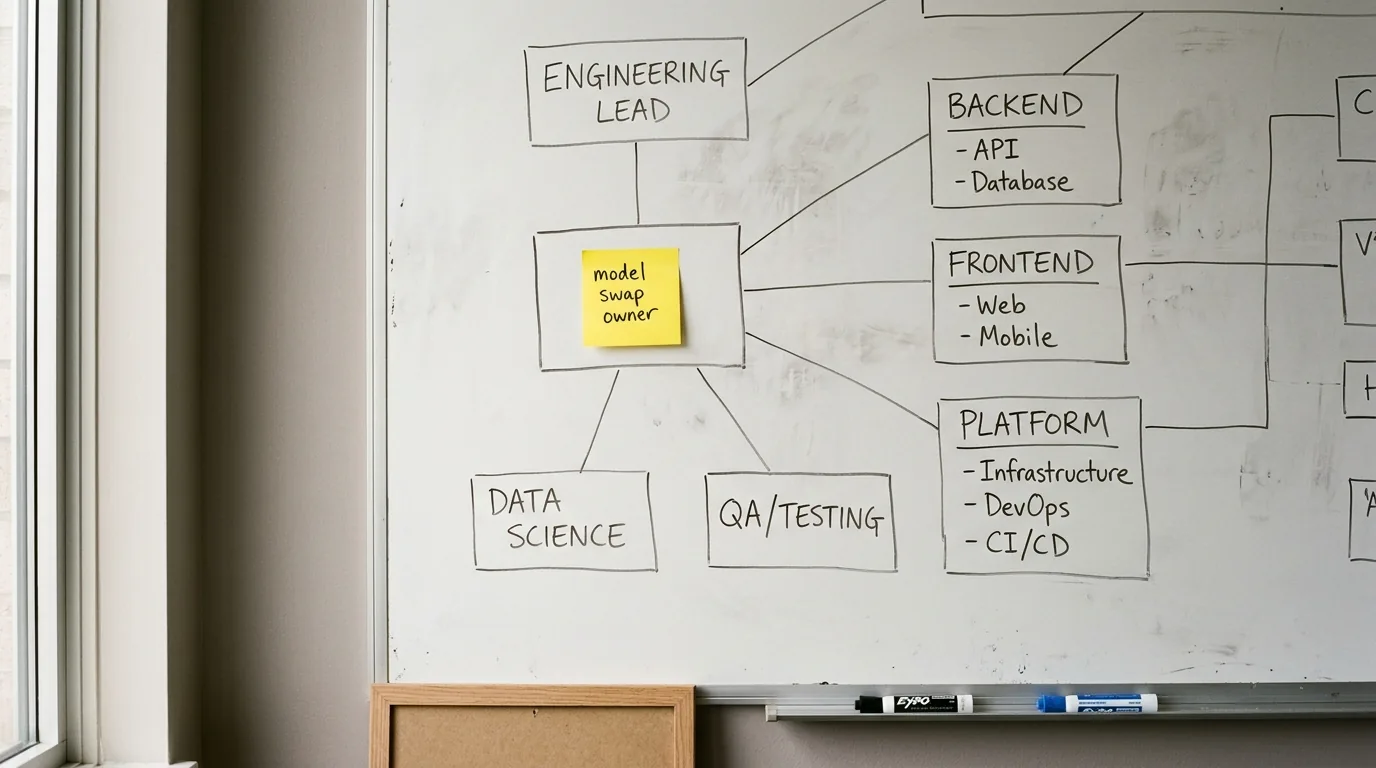
GitHub flipped the Copilot Business base model on May 17. OpenAI merged ChatGPT and Codex on the same weekend. The question that should be on every engineering manager's desk this week is not which harness is best. It is who, by name, owns the response when a vendor swaps the model under the harness.
GitHub flipped the Copilot Business base model to GPT-5.3-Codex on May 17. OpenAI merged ChatGPT, Codex, and the developer API under Greg Brockman the same weekend. Claude Code 2.1.143 started showing projected per-turn token cost on every plugin. None of those are tool decisions. They are org-design decisions, and most engineering teams have not named the person who owns the response.
The setup
I was in a video call on Monday with an engineering director at a mid-stage SaaS company. About 180 engineers. Big Copilot Business contract. We were halfway through a routine quarterly check when she opened a Slack thread, scanned it, and went quiet for about ten seconds.
The thread was from one of her staff engineers. The gist: “Did anyone notice Copilot is using a different model since yesterday? My PR comments are different. Also longer. Also slightly worse on Go.”
That was the GPT-5.3-Codex base-model activation. It landed on May 17 for every Copilot Business and Copilot Enterprise tenant, with a 1x premium request multiplier and no per-developer opt-out. The GitHub changelog from March 18 had said it would happen “within 60 days.” Sixty days from March 18 lands on May 17. The math was always there. The org response was not.
This is the part I keep seeing. Vendor moves are deterministic and announced. The engineering team’s response is improvised and owner-less.
What she tried
Her first instinct was the right one for someone who lived through the cloud migration era. She tried to map the response onto an existing role.
First attempt was the platform team. The reasoning made sense: platform owns developer tools, platform owns IDE configuration, therefore platform owns the model-swap response. The platform lead pushed back politely. His team was three people. They were already underwater on the Cursor 3.4 multi-repo cloud agent rollout and the GitHub Copilot CLI deprecation warning audit. He could acknowledge the swap. He could not own the response across 180 engineers writing in twelve languages.
Second attempt was the on-call rotation. This one tends to look elegant on paper. Everyone takes a week, the model-swap response becomes part of incident triage, and the load is distributed. Two problems showed up by Tuesday morning. The on-call engineer for that week did not have a baseline of what code review comments used to look like before the swap, so she could not judge what “different” actually meant. And the response time horizon was wrong. Model swaps are not incidents. They are slow drift across days, not pages at 2am.
Third attempt was the engineering manager line. Each manager owns the response for their team. This is closest to right and the easiest to get wrong. Without a shared rubric, eleven managers produce eleven different verdicts on the same model swap. Two of them say “we are fine.” Three say “we have a regression on Python tests.” Two say “Go is slightly worse.” Four do not look at all because their team did not surface it.
By Wednesday she had a Notion doc titled “model swap response” with no name in the owner field.
Where it broke and where it worked
The break was not in any of the three attempts. The break was earlier.
The team had treated the harness as a developer tool, the way you treat an IDE plugin or a linter. Plugins do not silently change behavior across an entire engineering org on the vendor’s calendar. The harness now does. That is the new fact. The org chart had not absorbed it.
What worked, in the same week, was a different team. A 60-person engineering org I have been talking with for a few months. Their CTO had read the March 18 LTS announcement on March 19 and named someone on April 1.
The role had a deliberately ugly title: harness operations lead. One staff engineer, half-time, with three written responsibilities. Maintain a small sample of “before” prompts and PR comments that get re-run after every announced model swap or harness release. Publish a one-page note within seventy-two hours of any swap, with three findings and a verdict. Own the kill-switch runbook in case the verdict is “this is worse and we need to roll back at the tenant policy level.”
That team had a written verdict by Tuesday May 19, two days after the GPT-5.3-Codex flip. The verdict was nuanced. Faster on agentic refactors. Slightly more verbose on PR review. Visibly worse on one specific pattern, where the previous model had been doing aggressive deduplication of test setup code and the new model was not. The team did not roll back. They updated three internal prompts. The verdict took twelve hours of one person’s time.
That number is the part most engineering teams have not internalized. MarkTechPost ran a benchmark-driven survey on May 15. The headline finding was not which model wins. It was that scaffolding produces a same-model spread of 17 problems on SWE-bench Verified. As the piece put it:
"three different frameworks running identical Opus 4.5 models scored 17 problems apart across 731 test cases"
If the harness scaffolding around the same model can move 17 problems on a 731-problem benchmark, then “the model changed” is not a model question. It is a harness-plus-scaffolding question. Which means the response has to live with the team that owns the scaffolding, not the team that owns the procurement contract.
The pattern
Three structural moves landed in the same 72-hour window, and together they explain why this owner question is suddenly load-bearing.
GitHub Copilot Memory shipped user-level preferences on May 15, scoped per individual developer at github.com/settings/copilot/memory rather than per repo or per admin. Anthropic shipped Claude Code 2.1.143 the same day with plugin dependency chains and projected per-turn token cost surfaced at install-time in the marketplace. OpenAI told employees that ChatGPT, Codex, and the developer API would merge into a single agentic product organization under Greg Brockman, with Thibault Sottiaux running core product and platform across consumer, enterprise, and developer surfaces.
Three vendors. Three different kinds of move. One underlying message. The configurable surface is multiplying, and the layer at which it lives is shifting. Some of it shifts down to the individual developer (Copilot Memory user preferences). Some of it shifts up to a single vendor counterparty (OpenAI unification). Some of it surfaces costs that used to be invisible (Claude Code projected token cost on plugins).
Every one of those moves changes who in the engineering org needs to make a judgment call. None of them changes the org chart on its own. That is the manager's job, and the gap between "vendor changed something" and "we have a named owner for the response" is where productivity quietly leaks.
The pattern I keep watching is simple. Teams that named an owner before the next swap landed on May 17 had a verdict within seventy-two hours. Teams that did not are still in Slack threads on Tuesday May 19, asking the staff engineer who first noticed whether anyone else is seeing it too.
What I’d tell you over coffee
If we were sitting across a table this week, here is what I would say.
Pick one person on your team and write three sentences. First sentence: this person owns the response when a vendor swaps a base model, releases a harness version that changes scaffolding behavior, or restructures their product surface in a way that lands inside our license. Second sentence: their deliverable is a written one-pager within seventy-two hours of any such event, with a verdict and three findings. Third sentence: they own the kill-switch runbook for the cases where the verdict is “roll back at the tenant policy level.”
That is the entire org-design change. It does not require a platform team. It does not require a new role on the ladder. It requires one name, three sentences, and a small sample of “before” prompts kept somewhere you can re-run them.
The next swap is coming. Google I/O opens on May 19, which is tomorrow, and there are at least two more harness vendors I can name who are going to ship something inside the next ten days. The question is not whether the swaps will keep happening. The question is whether your team will keep finding out about them in a Slack thread, ten seconds after your director opens it.
Name the owner this week.
Sources
- OpenAI merges ChatGPT and Codex under Greg Brockman. The side quests are over. - TheNextWeb, 2026-05-17
- OpenAI to Give Greg Brockman Control of Product Strategy - WinBuzzer, 2026-05-17
- OpenAI Unifies ChatGPT, Codex, and Developer API Under Co-Founder Brockman Four Days Before Google I/O - TechTimes, 2026-05-16
- Copilot Memory supports user preferences for Pro, Pro+ users - GitHub Changelog, 2026-05-15
- Claude Code 2.1.143 release notes - Anthropic via Releasebot, 2026-05-15
- Best AI Agents for Software Development Ranked: A Benchmark-Driven Look at the Current Field - MarkTechPost, 2026-05-15
- GPT-5.3-Codex long-term support in GitHub Copilot - GitHub Changelog, 2026-03-18