Your coding agent's control plane just became an org-chart question: who owns it?
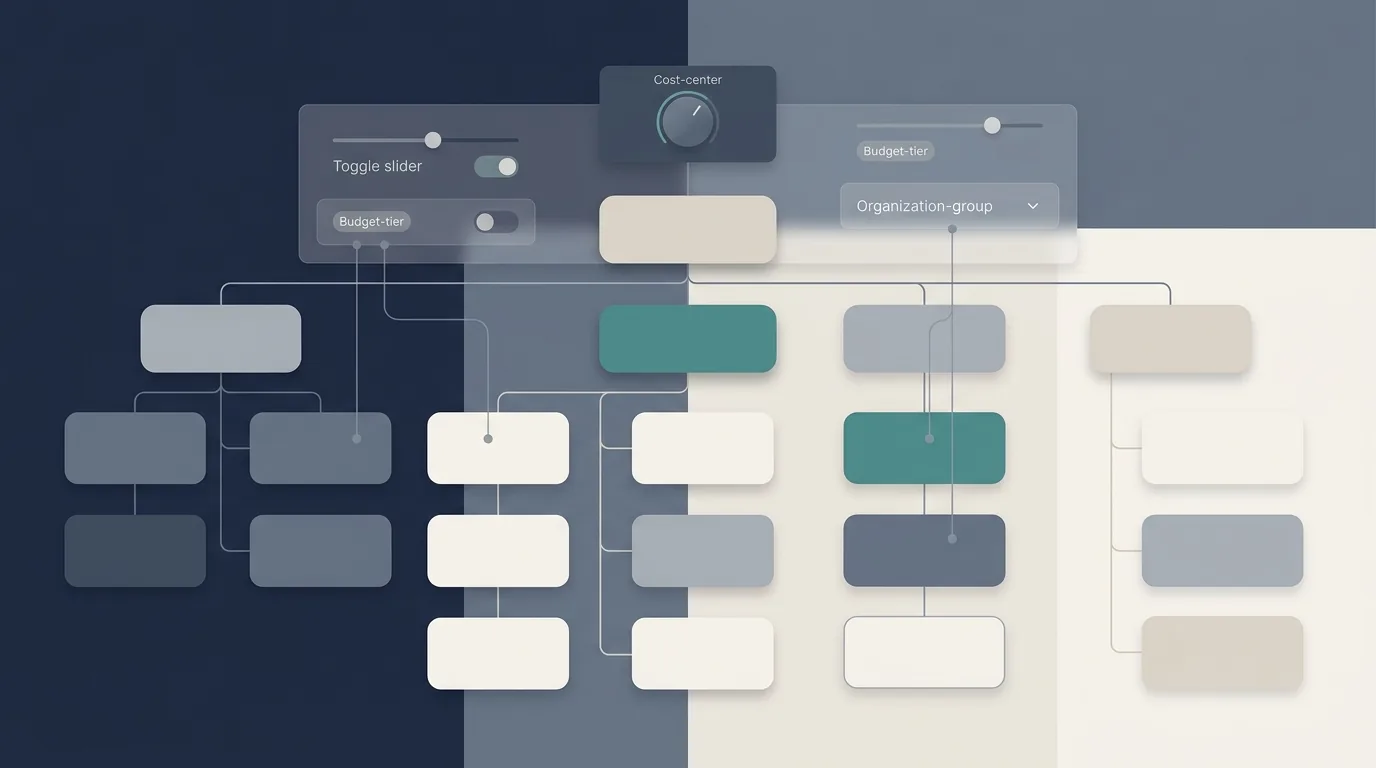
Three coding-agent vendors shipped admin and org-console governance knobs this week, and each one now maps to a team boundary. The org-design question is who owns that mapping before it silently lands on your senior engineers.
This week GitHub, Cursor, and Anthropic all shipped admin and org-console governance knobs for their coding agents, and each knob quietly maps to a team boundary: a cost center, an org group, a default model. The org-design decision hiding inside those release notes is who owns the mapping from those controls to the real team structure. Name that owner on the org chart, or the work lands on the senior engineers by default.
I spent Tuesday morning reading release notes, which is the glamorous life you sign up for when you care about this stuff. One line from the GitHub changelog stopped me. Dated June 30, they shipped per-user AI credit budgets for cost centers, and the worked example they chose to explain it was not about billing at all. It was about your org chart.
Here is the exact framing they used: you could put your platform engineering team in one cost center at $250 per user and keep everyone else on a $40 universal budget, without setting budgets one user at a time. Read that again as an engineering leader, not as a finance person. A vendor just described a team topology back to its customer and attached a per-engineer dollar ceiling to each box. The control plane stopped being a settings page. It became a map of who does what.
"You could put your platform engineering team in one cost center at $250 per user and keep everyone else on a $40 universal budget, without setting budgets one user at a time."
The week three vendors shipped a governance layer keyed to team boundaries
That GitHub budget release was not a one-off. Look at what landed in the same 48 hours and a pattern jumps out.
Cursor, also on June 30, made team marketplaces support organization groups. In plain terms: an admin configures a set of approved MCP servers once, then distributes them to specific org groups across cloud agents, the agents window, the IDE, and the CLI. Which tools an agent can reach is now a function of which org group an engineer sits in. That is team topology deciding tool access.
Anthropic shipped Claude Code v2.1.196 the same day. The headline line for our purposes: organization default models, set by admins in the org console. Alongside it, a security fix that matters more than it looks, where claude mcp list and get no longer spawn .mcp.json servers that a repo had self-approved through a committed .claude/settings.json. So the default model an agent runs is now an org-level decision, and a repo can no longer quietly grant itself tool access through a checked-in config file. Both of those are governance moving up from the individual engineer to the org.
And GitHub, one more time on June 30, made Copilot a first-class option in the JetBrains AI Assistant agent picker, with model and reasoning-depth selection right in the chat. The org’s agent choice now surfaces inside a third-party IDE that the org did not build.
I keep a running mental note of what harness vendors compete on, and for months the honest answer has been benchmarks and model quality. This week nobody shipped a smarter model. They shipped cost centers, org groups, org default models, and org-scoped agent pickers. The competition moved to the admin console. Uplevel put the underlying question well in a piece a few days earlier, on June 26, titled simply “who owns what now.” Their point was that AI is blurring the old boundaries between product, engineering, QA, and platform, and most organizations have not answered the ownership question because they are still measuring people for jobs that changed shape underneath them.
Nobody shipped a smarter model this week. They shipped cost centers, org groups, and org default models. The competition moved to the admin console.
The knob exists, the owner does not, and that gap has a cost
Here is where it gets uncomfortable, and I say this having watched it play out in real teams. Every one of those controls presupposes a person who owns it. Someone decides which cost center the platform team sits in and why $250 and not $150. Someone decides which org groups get which MCP servers. Someone picks the org default model and owns it the day that model gets deprecated or, as we saw last month, gets pulled by an export-control event overnight. Someone re-tests the committed-config security fix to confirm no repo in the estate was self-approving servers before the patch.
The vendors built the knobs. They did not build the owner. And when a control exists with no named owner, one of two things happens. Either it sits at its default, which means the default nobody set is the one the vendor chose. Or the work of setting it correctly, and keeping it correct release over release, quietly flows to whoever notices first. In most engineering orgs, the person who notices first is a senior or staff engineer who was already the busiest person on the team.
That is the org-design failure I want to name plainly. Not “AI will shrink the team.” The team-size debate gets all the airtime and misses the operational reality. The reality is that a new class of work appeared this week, the work of owning the control plane, and it has no box on the org chart. So it defaults onto the seniors on top of everything else they already carry. InfoWorld captured the adjacent version of this back in early May, quoting Mastra’s Abhi Aiyer that one person can now run a whole feature project with an army of agents behind them, while review throughput becomes the new bottleneck. The bottleneck and the control-plane ownership tend to land on the same shoulders.
The risk is not that coding agents shrink your team. It is that they create a new job, owning the control plane, that no one is staffed to do, so it silently accretes onto the senior engineers who were already the constraint.
There is a calmer way to read all this, and it is the accurate one. None of these releases are emergencies. A cost center left unconfigured is not on fire. An org default model left unset is running the vendor’s choice, which is usually reasonable. The point is not to panic-configure everything by Friday. The point is to notice that a coherent new surface has formed, and to decide, on purpose, who tends it.
Why the control plane belongs on the org chart, not in the settings tab
Step back and the pattern connects to something the Anthropic 2026 Agentic Coding Trends Report named earlier this year: the delegation gap. Developers now lean on AI for roughly 60% of their work but can fully hand off only 0 to 20% of tasks. The gap is filled with human judgment: setup, prompting, supervision, validation. What this week’s releases show is that the same gap exists one level up, at the org layer. The vendors delegated the mechanism, the cost center and the org group and the model policy. They did not and cannot delegate the judgment about how those map to a specific set of teams. That judgment is the job.
So the control plane is not a settings tab that IT quietly manages. It is an org-chart artifact. The cost-center-to-team mapping encodes which teams an org is willing to let spend more, which is a statement about where the real payoff is believed to be. The org-group-to-MCP mapping encodes which teams get trusted with which capabilities, which is a risk decision. The org default model encodes the fallback posture for the day a model disappears. These are engineering-leadership calls wearing the costume of admin settings. Treat them as settings and the real decisions get handed to whoever clicks last.
The healthy version I have seen work is boring and effective: one named owner for the control plane per harness, the way a critical service gets a named owner. Not a committee, not a Slack channel, not “platform will get to it.” A person whose job description includes keeping the org-console configuration current and defensible, and who has thirty minutes on the calendar each time a harness ships a governance release, which is now roughly weekly. That is the whole intervention. It sounds small. It is the difference between a control plane an org runs and one that runs the org.
What I’d tell you over coffee
If you lead an engineering org, here is the honest version. The coding-agent vendors just spent a week saying, in the polite language of changelogs, that governance is now the customer’s problem and the levers have been handed over. That is good news dressed as homework. The levers are real and mostly well designed. What is missing is a name next to each one.
So before the next sprint planning, do the least glamorous thing on the list. Open each harness admin console, write down the controls that shipped this month, and put one human name beside each. If the honest answer for any of them is “nobody, it’s on default” or “whichever senior engineer noticed,” that is the org-design gap that matters far more than the headcount question everyone is arguing about. Fill it deliberately, and the whole thing feels figure-out-able again, because it is.
Sources
- Per-user AI credit budgets available for cost centers - GitHub Changelog, 2026-06-30
- Copilot Agent is now available in JetBrains AI Assistant - GitHub Changelog, 2026-06-30
- What's New in Cursor: Team MCPs and organization groups - Cursor Changelog, 2026-06-30
- Claude Code release notes (v2.1.196, v2.1.197) - Releasebot / Anthropic Claude Code, 2026-06-30
- AI Engineering Team Structure: Who Owns What Now? - Uplevel, 2026-06-26
- What happens when engineering teams reorganize around AI agents - InfoWorld, 2026-05-08
Written by Kinan Hamwi, Founder of Cerevisor.